
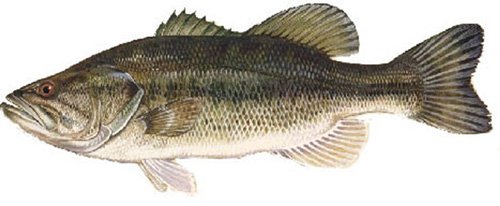
“Black bass” is the historical common name for the entire genus Micropterus, including largemouth, smallmouth, and spotted bass, not a description of any single fish’s color. The name predates “largemouth bass” by decades and still survives today in official fishing regulations, which typically set one combined “black bass” bag limit covering all species in the genus rather than separate limits for each.

Where Did the Name “Black Bass” Come From?
“Black bass” was the standard English common name applied to Micropterus species throughout the 19th century, well before “largemouth bass” and “smallmouth bass” became the dominant everyday terms. Early American naturalists and anglers used it as an umbrella term to distinguish freshwater Micropterus species from the many unrelated fish already carrying the name “bass,” including striped bass, white bass, and various saltwater species. The name likely reflects the darker, olive-to-blackish coloration these fish can take on in tannin-stained, heavily vegetated water, though individual largemouth bass actually range from pale green to nearly black depending on water clarity and habitat, so the name was always more of a genus-wide label than a precise color description of any one fish.
Is “Black Bass” the Same Thing as “Largemouth Bass”?
Not exactly. “Largemouth bass” refers to one specific species (or two, per the 2022 taxonomic split covered in a companion article on this site) within the genus. “Black bass” is the broader umbrella term for the whole genus Micropterus, which today includes largemouth, smallmouth, spotted, Alabama, Suwannee, shoal, and several other more range-restricted species. Every largemouth bass is a black bass, but not every black bass is a largemouth bass.
Why Do State Fishing Regulations Still Use “Black Bass”?
Because multiple Micropterus species often share the same lakes and rivers and can be difficult for anglers to tell apart at a glance, most state wildlife agencies write bag and size limits under a single combined “black bass” category rather than tracking each species separately. Missouri’s daily and possession limit, for example, is written as 12 “black bass” total, with no more than 6 largemouth and smallmouth combined. Texas sets a combined 5-fish daily bag for largemouth, smallmouth, Alabama, Guadalupe, and spotted bass under the same umbrella. Florida’s rule allows 5 “black bass” per day, covering Florida bass, largemouth, Suwannee, spotted, Choctaw, and shoal bass together, with only one fish permitted at 16 inches or longer. This regulatory convenience is the main reason “black bass” has survived as active, official terminology for a century and a half after it fell out of everyday conversational use.
| State | Species Covered Under “Black Bass” | Combined Daily Limit |
|---|---|---|
| Florida | Florida bass, largemouth, Suwannee, spotted, Choctaw, shoal bass | 5 total, only 1 over 16 in |
| Texas | Largemouth, smallmouth, Alabama, Guadalupe, spotted bass | 5 total (any combination) |
| Missouri | Largemouth, smallmouth, spotted bass | 12 total, max 6 largemouth/smallmouth combined |
| Oklahoma (rivers/streams) | Largemouth, smallmouth, spotted bass | 6 total, only 1 smallmouth |
Why Did “Largemouth Bass” Become the More Common Name?
As recreational and later competitive bass fishing exploded in popularity from the mid-20th century onward, particularly after Ray Scott founded B.A.S.S. in the late 1960s, anglers and media needed a way to talk about specific species rather than the genus as a whole, since largemouth and smallmouth bass behave, look, and get targeted differently enough to matter to a serious angler. “Largemouth” and “smallmouth,” both descriptive of the most visually obvious identification trait between the two, a jaw stretching past the eye versus one that does not, proved simpler and more precise for everyday conversation than “black bass,” which said nothing about which species you meant. “Black bass” never disappeared, it simply retreated into the more formal, regulatory, and scientific contexts where a genus-level term is genuinely more useful than a species-level one.

Does “Black Bass” Show Up Anywhere Else Besides Regulations?
Yes, in a few surviving pockets. Fisheries science literature and academic papers studying Micropterus species as a group still routinely use “black bass” in titles and abstracts, since it is the accurate, established scientific umbrella term for the genus and reads more naturally than repeatedly listing every species by name. Some older fishing clubs, conservation organizations, and taxidermy or record-keeping traditions in the southeastern United States, where the genus originates and where “black bass” saw its heaviest historical use, still carry the name in their titles or record categories. A handful of state agencies also use “black bass” in the formal titles of their fishing regulation sections even while referring to individual species by their common names elsewhere in the same document, a naming split that can confuse anglers checking regulations for the first time and mistakenly think black bass is a distinct species from largemouth bass rather than the category that contains it.
Frequently Asked Questions
Is largemouth bass a black bass?
Yes. “Black bass” is the umbrella name for the entire genus Micropterus, and largemouth bass is one species within that genus, alongside smallmouth, spotted, and several other species.
Why is it called black bass if the fish isn’t black?
The name reflects the darker olive-to-blackish coloration these fish can show in tannin-stained or heavily vegetated water, but it was always used as a genus-wide label rather than a literal, precise color description of any single fish.
Do fishing regulations still use the term black bass?
Yes, extensively. Most states set combined bag and size limits for “black bass” covering largemouth, smallmouth, spotted, and other Micropterus species together, rather than listing separate limits for each one.
Which came first, “black bass” or “largemouth bass”?
“Black bass” is the older term, in wide use through the 19th century. “Largemouth bass” became the dominant everyday name later, largely as bass fishing grew into a species-specific sport and industry in the 20th century.