
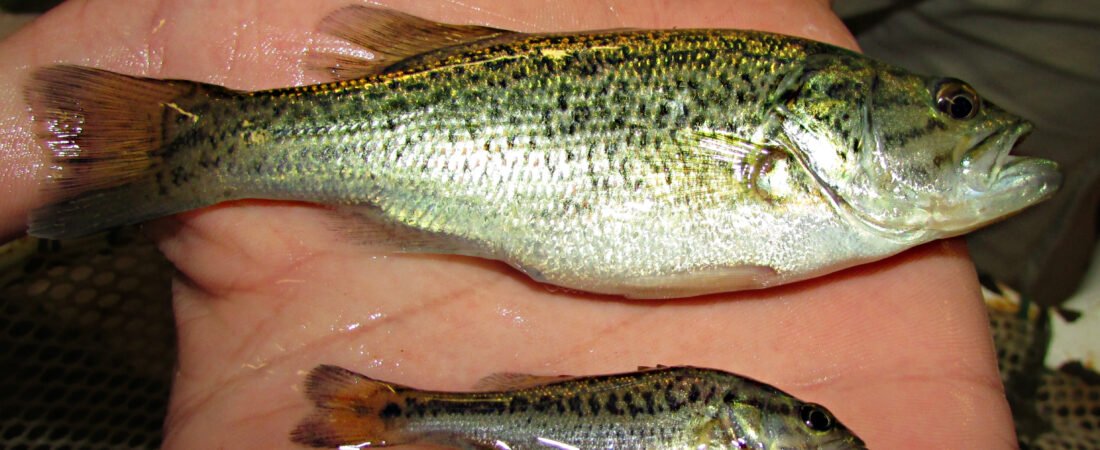
A largemouth bass can grow to roughly 29 to 30 inches and 22-plus pounds under exceptional conditions, but the biology behind that ceiling matters more than the record number itself. Genetics, forage supply, growing-season length, and water temperature all interact to determine how big any individual fish can actually get.

How Fast Do Largemouth Bass Grow?
Growth is fastest in the first few years of life and slows sharply afterward. Under good conditions a largemouth typically gains close to an inch of length per year through its first four years, reaching roughly 12 inches and under a pound by age three in a productive reservoir. After that, annual growth in length drops off substantially even as weight continues climbing, since an older fish is packing on mass relative to an already-established frame rather than lengthening quickly. A fish that reaches 29 inches and nearly 16 pounds by age ten, a benchmark recorded in a well-studied North Carolina reservoir, represents a fish that kept growing steadily for a full decade rather than one that shot up quickly and then stalled.
| Age | Length | Weight |
|---|---|---|
| 1 year | ~7 in | Under 0.25 lb |
| 3 years | ~12 in | ~0.87 lb |
| 5 years | ~16-17 in | ~2-3 lb |
| 10 years | ~29 in | ~15.9 lb |
These figures come from a single well-documented reservoir population and will vary significantly elsewhere; a bass in a nutrient-poor northern lake with a short growing season will fall well short of this pace at every age.
What Determines a Largemouth Bass’s Maximum Size?
Four factors interact to set the ceiling for any individual fish. Genetics matters first: Florida-strain largemouth (the lineage now classified as Micropterus salmoides after the 2022 species split) carry a genuine biological advantage for reaching large size compared with the more widespread northern lineage, Micropterus nigricans, which is why many trophy-fisheries programs specifically stock Florida-strain fingerlings. Growing-season length matters just as much: bass in warm climates feed and grow for more months of the year than bass in short-season northern water, and growing-season length has been shown to explain more of the difference in growth rates between regions than genetics alone. Forage abundance sets a hard ceiling regardless of genetics or climate, since a bass in a food-poor lake simply cannot convert calories it never eats into size. Population density plays a role too: lakes with too many bass competing for the same forage base tend to produce more average-sized fish and fewer true giants than lakes managed to keep bass numbers lower relative to available food.
What Counts as a “Genuinely Exceptional” Bass Today?
Most anglers will never catch anything close to record weight, and that is by design of the species’ biology rather than a failure of skill. A bass over 8 pounds is considered a legitimate trophy in the large majority of American waters, and Florida’s own TrophyCatch program sets its entry threshold at exactly that weight for a reason. A fish over 13 pounds qualifies for TrophyCatch’s Hall of Fame and represents a genuinely rare catch even in Florida’s ideal conditions, and anything approaching the high teens or twenties is functionally a once-in-a-lifetime fish, requiring the rare combination of Florida-strain genetics, a long uninterrupted growing season, abundant forage, and enough years undisturbed to actually reach that size.
Does a Bass Ever Stop Growing?
Growth slows dramatically with age rather than stopping outright, and very old largemouth bass can continue adding small amounts of weight even after their length has essentially plateaued. Lifespan itself varies by climate in the same way growth rate does: southern bass tend to grow fast but live shorter lives, averaging around 10 years with a maximum near 16, while northern bass grow more slowly but can live substantially longer, with documented maximum ages of 23 to 24 years. A genuinely old bass in cold northern water may never reach the outright size of a much younger Florida-strain fish, since the growing-season and genetic advantages of the South tend to outweigh the extra years available to a long-lived northern fish.
Frequently Asked Questions
How big can a largemouth bass realistically get?
Under exceptional conditions, roughly 29 to 30 inches and over 20 pounds, though the vast majority of largemouth bass never exceed a few pounds. A fish over 8 pounds is considered a genuine trophy in most waters.
Do largemouth bass keep growing their whole life?
Growth continues but slows dramatically with age. Most length gain happens in the first four years, after which a bass adds weight more than length as it ages.
Why do female largemouth bass get bigger than males?
Female largemouth bass have a documented biological growth advantage over males of the same age and conditions. Nearly every double-digit trophy bass on record is a female.
What is the biggest factor in how big a largemouth bass gets?
No single factor dominates. Genetics (particularly Florida-strain lineage), growing-season length, forage availability, and population density all interact to set an individual fish’s maximum size.