
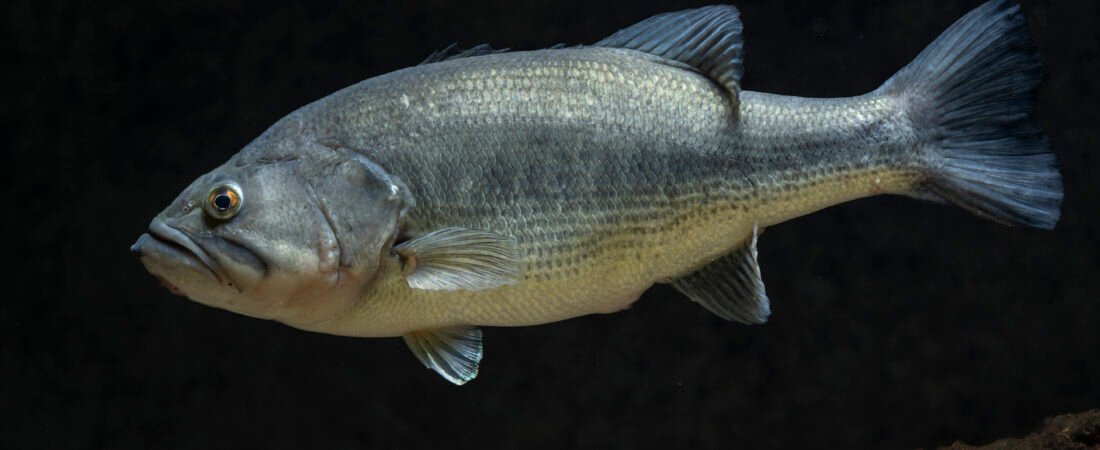
Most anglers know the largemouth bass as America’s favorite gamefish, but far fewer know that it can see color, was scientifically split into two species in 2022, or that its world record was matched on the other side of the planet 77 years after it was set. Here are 12 verified facts that go beyond the basics.

12 Largemouth Bass Facts Most People Do Not Know
Its lateral line lets it strike in total darkness. A largemouth bass’s lateral line is a row of fluid-filled pores running along each side of its body that detects the pressure wave of a moving prey fish. This sense is sharp enough that a bass can track and strike a fleeing baitfish in muddy or nighttime water without ever seeing it, which is why lures with strong vibration or thump often outperform purely visual ones in stained water.
It sees color, and it favors red and green. Unlike many freshwater fish, largemouth bass have color vision and are especially sensitive to red and green wavelengths in clear, shallow water, part of why so many productive lure colors and blood-red hook details are built around that specific sensitivity. In deeper or murkier water, where light penetration drops off, that color advantage matters far less than vibration and silhouette.
It is the official state fish of four different states. Largemouth bass hold official state fish status in Georgia (designated 1970), Alabama (1975), Mississippi (1974), and are also claimed as a state symbol in Florida, making it one of the most officially honored freshwater fish in the country and a rare species with that level of formal recognition across multiple states at once.
A single female can lay thousands of eggs across multiple nests in one season. Female largemouth bass are polyandrous periodic spawners, producing roughly 2,000 to 7,000 eggs per pound of body weight and distributing them across nests with several different males over the course of a spawning season rather than mating with one partner. A five-pound female is capable of producing well over 10,000 eggs in a single season.
The species has technically been split into two since 2022. A genome-wide study reassigned the widespread northern largemouth population to a newly recognized species, Micropterus nigricans, while the Florida population kept the original name Micropterus salmoides. Almost no one outside ichthyology has changed how they talk about the fish as a result, and no state agency or record-keeping body has split its regulations or record books along the new species line.
It has been introduced to more than 50 countries on five continents. Stocking efforts date back to the 1880s, with largemouth bass reaching Hawaii as early as 1897 and Puerto Rico by 1915. Today the species is established on every continent except Antarctica, prized as a sport fish in most places and formally managed as an invasive species in others, sometimes both at once in the same country.
The world-record fish was tied 77 years later, on the other side of the planet. George Perry’s 22 lb 4 oz largemouth, caught in a Georgia oxbow in 1932, stood alone until Manabu Kurita landed an identical 22 lb 4 oz bass in Japan’s Lake Biwa in 2009. IGFA rules require beating the old record by at least 2 ounces, so the two catches are recognized as co-record holders rather than one replacing the other, an outcome that has never happened at this level in any other major gamefish record.
Its name comes from a damaged museum specimen, not the live fish. The genus name Micropterus, meaning small fin in Greek, was coined in 1802 from a preserved specimen with a torn, oddly shaped dorsal fin. Live largemouth bass do not actually have unusually small fins, making the name a two-century-old case of a taxonomic label built on a technicality rather than a real anatomical trait.
Bass fishing supports a tournament industry Ray Scott built almost from scratch. Professional bass tournament fishing barely existed before Ray Scott organized his first event in 1967 and founded B.A.S.S. the following year. The Bassmaster Classic grew from about two dozen competitors at Lake Mead in 1971 into the sport’s biggest annual event within a few decades, and the broader bass fishing economy today is estimated in the tens of billions of dollars annually.
It can live twice as long in the north as in the south. Warmer southern waters produce faster-growing bass with shorter lifespans, averaging around 10 years with a maximum near 16. Colder northern waters slow growth but extend maximum lifespan to roughly 23 to 24 years, more than double the typical southern lifespan, even though northern fish generally end up smaller at any given age.
Its mouth can swallow prey nearly a third of its own body length. The largemouth’s oversized, hinge-like jaw and expandable throat allow it to engulf prey, including other fish, frogs, and even small waterfowl, that are disproportionately large relative to its own body size, a major reason it can dominate the top of the food chain in small ponds where no larger predator fish are present.
It is technically more closely related to bluegill than to striped bass. Because largemouth bass belong to the sunfish family Centrarchidae, its closest relatives in the pond are panfish like bluegill and crappie, not the unrelated, similarly named striped bass or saltwater sea bass that belong to entirely different fish families. The shared word “bass” across dozens of unrelated species worldwide is a quirk of common naming, not a reflection of any real biological relationship.
Taken together, these facts point to the same conclusion: the largemouth bass earned its status as America’s most popular freshwater gamefish through a combination of genuine biological adaptability and a tournament industry that built an entire recreational economy around one species. Few other freshwater fish carry that much scientific, cultural, and economic weight at once.
Frequently Asked Questions
What is the most surprising fact about largemouth bass?
Among the least known: the species was genetically split into two, Micropterus salmoides and Micropterus nigricans, in 2022, though almost no angler or state agency has changed how they refer to the fish as a result.
Can largemouth bass see color?
Yes. Largemouth bass have color vision and are especially sensitive to red and green wavelengths, which is part of why so many effective lure colors are built around those two hues.
How many states have the largemouth bass as their official state fish?
Four: Georgia, Alabama, Mississippi, and it is also claimed as a state symbol in Florida.
How long can a largemouth bass live?
Lifespan depends heavily on climate. Southern bass average around 10 years with a maximum near 16, while northern bass can live an average of 15 years and as long as 23 to 24 years.