
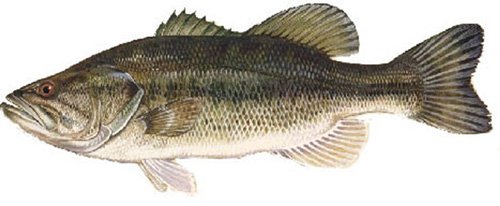
Spotted bass are the black bass species most often mistaken for largemouth, since both share a similar shape and greenish coloring. The one feature that never fails is the tongue: spotted bass have a rough, rectangular tooth patch on the tongue, and largemouth bass do not.

Why Are Spotted Bass So Often Confused With Largemouth?
Spotted bass sit visually between largemouth and smallmouth in a way that smallmouth simply does not. Their body color runs silver-white to brassy green with dark olive mottling, close enough to a largemouth’s coloring that anglers glancing quickly can miss the difference, especially on a young or mid-sized fish. Their jaw is also intermediate: it comes closer to the eye than a true largemouth’s does but can still look deceptively long at a glance, unlike a smallmouth’s clearly shorter jaw. Spotted bass are also known regionally as “Kentucky bass,” and in waters where all three black bass species overlap, misidentifying a spotted bass as a small largemouth is one of the most common ID mistakes anglers make.
What Is the One Reliable Way to Tell Them Apart?
Check the tongue. Spotted bass have a distinct rough, rectangular tooth patch at the center of the tongue, a feature completely absent in largemouth bass, whose tongue surface is entirely smooth. This single trait is more reliable than color, jaw length, or spot pattern, all of which can vary enough between individual fish to cause confusion. Beyond the tongue, spotted bass typically show rows of small, distinct dark spots below the lateral line that fade gradually toward the belly, a pattern largemouth bass do not share in the same organized rows, along with a dorsal fin whose notch is shallower than a largemouth’s deep, near-split notch.
| Feature | Spotted Bass | Largemouth Bass |
|---|---|---|
| Tongue | Rough, rectangular tooth patch | Completely smooth |
| Jaw | Ends near the eye, not clearly past it | Extends well past the eye |
| Body spots | Organized rows of small dark spots below the lateral line | Blotchy, irregular stripe, no organized rows |
| Dorsal fin | Shallow notch | Deep notch, nearly two fins |
| Max size | World record roughly 11 lb | World record 22 lb 4 oz |
Where Do Spotted Bass Range Compared to Largemouth?
Spotted bass have a much more limited native range than largemouth. Their native distribution runs through the Mississippi River basin from southern Ohio and West Virginia south to southeastern Kansas and the Gulf, along with Gulf Slope drainages from Georgia’s Chattahoochee River west to Texas’s Guadalupe River, essentially a band through the mid-South and lower Midwest. Largemouth bass, by contrast, are native across a far wider swath of central and eastern North America and have since been stocked in all 50 states. Where the two overlap, spotted bass tend to favor deeper, clearer water with more current or rocky bottom than largemouth prefer, closer to smallmouth-style habitat, which is part of why the two species often segregate by depth and structure even within the same lake or river system.
Does It Matter for Regulations if You Catch a Spotted Bass Instead of a Largemouth?
In many states, yes, at least practically. Several states, including Texas, Missouri, and Oklahoma, set combined “black bass” bag limits covering largemouth, smallmouth, and spotted bass together, so misidentifying one for another rarely creates a legal problem under those combined limits. However, spotted bass are increasingly managed differently from largemouth in some watersheds, particularly where introduced spotted bass populations are considered a threat to native smallmouth or other stream fish, so anglers fishing river systems with special spotted-bass regulations should confirm the specific rules for that water rather than assuming a combined statewide limit applies everywhere.
Frequently Asked Questions
What is the easiest way to tell a spotted bass from a largemouth bass?
Check the tongue. Spotted bass have a rough, rectangular tooth patch on the tongue that largemouth bass completely lack. This is more reliable than color or jaw length, both of which can look similar between the two species.
Why do people confuse spotted bass with largemouth bass?
Spotted bass share a similar greenish body color and a jaw length that can look deceptively close to a largemouth’s at a glance, unlike smallmouth bass, which are more visually distinct from largemouth.
Are spotted bass and largemouth bass found in the same water?
Often, yes, especially in the mid-South and lower Midwest where their ranges overlap. Spotted bass tend to hold in deeper, clearer, more current-driven water than largemouth within the same system.
Do spotted bass grow as large as largemouth bass?
No. The spotted bass world record is roughly 11 pounds, less than half the largemouth bass world record of 22 lb 4 oz.