
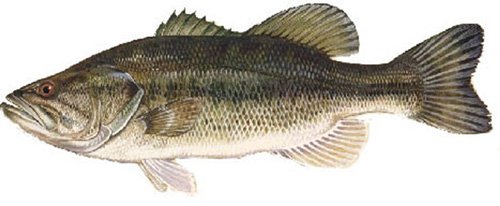
A largemouth bass’s color is not fixed. The same fish can look pale silvery-green in clear water and nearly black in tannic, weed-choked water, because largemouth bass actively adjust their pigment to match their surroundings. The one constant is the pattern underneath: a broken, diamond-blotched lateral stripe running from gill to tail.

What Color Is a Largemouth Bass, Really?
Base coloration runs from silvery-white through brassy-green to olive on the back, fading to a white or pale-yellow belly, but that range exists because largemouth bass have chromatophores, pigment-containing cells in the skin that expand or contract to darken or lighten the fish’s appearance in response to its surroundings. A bass pulled from clear, sandy-bottomed water typically shows brighter, more silvery tones, while a bass from stained, tannin-heavy water with heavy vegetation can appear almost black. This is camouflage, not decoration: matching the substrate and light conditions makes the fish harder for both prey and predators to spot.
Why Do Some Largemouth Bass Look Almost Black?
Fish living in tea-colored, tannin-stained water, common in Florida, the Gulf Coast, and other heavily vegetated wetland systems, regularly darken to near-black, sometimes described by anglers as “swamp bass” coloring. This is a direct response to low light penetration and dark, organic-stained water rather than a separate subspecies trait, though it is more frequently reported in Florida-strain fish given how much of their native range consists of exactly this kind of water. The same fish moved to clearer water will typically lighten again over time.
What Does the Lateral Stripe Actually Look Like?
The largemouth’s signature marking is not a single continuous line but a row of connected, diamond-shaped or blotchy dark patches running from just behind the gill cover to the base of the tail. Under close inspection the “stripe” is really a chain of irregular blotches that can appear broken or interrupted in places, especially on older or heavily pigmented fish. This distinguishes it from a true continuous stripe, and it is one reason largemouth bass are sometimes confused with spotted bass, whose blotchy pattern is similar but generally more rows of smaller spots rather than one dominant chain.
Do Juvenile Largemouth Bass Look Different From Adults?
Young largemouth bass typically show a more pronounced, higher-contrast lateral stripe than adults, which can fade and become less distinct as the fish matures and its overall pigmentation darkens. This sharper juvenile patterning is part of why very young largemouth are sometimes mistaken for spotted bass, since the more defined blotch pattern resembles the spotted bass’s markings more closely than a mature largemouth’s does. Juveniles also tend to show a more silvery overall cast before developing the deeper olive-to-green tones of an adult fish.

Do Florida-Strain and Northern-Strain Largemouth Look Different?
Florida-strain largemouth bass tend to show a slightly deeper, more compact body profile and are anecdotally reported to run darker along the back and sides than northern-strain fish, though the difference is subtle enough that reliable visual identification in the field is difficult without genetic testing. The more dependable distinction between the two strains is growth rate and maximum size rather than color: Florida-strain fish grow faster and larger under the same conditions, which is why many southern states stock Florida-strain fingerlings specifically to boost trophy potential, not because they look noticeably different.
Are Female Largemouth Bass Bigger and Do They Look Different From Males?
Female largemouth bass grow significantly larger than males of the same age, and nearly every double-digit trophy bass caught is a female, since males rarely exceed a few pounds even at maximum age. Outside of size, there is no reliable external color or pattern difference between male and female largemouth bass visible to anglers; distinguishing sex typically requires examining the fish internally or during the spawn, when males are the ones actively guarding nests in shallow water. Body girth relative to length can hint at a gravid, egg-carrying female during spring, but this is a body-condition cue rather than a fixed visual marker.
What Color Are a Largemouth Bass’s Fins and Eyes?
Fins generally match or run slightly darker than the body’s base color, olive to dusky green, with no bright or contrasting fin coloration the way some panfish species show. The eyes are typically a golden to amber color with a dark pupil, and unlike some sunfish relatives, largemouth bass do not have the bright red eye that helps identify rock bass at a glance. Overall, the fin and eye coloring of a largemouth bass is understated compared to its more visually distinctive lateral stripe and jaw structure, which remain the most reliable features for identification regardless of the water it came from.
Frequently Asked Questions
Why do largemouth bass change color?
Largemouth bass have pigment cells called chromatophores that expand or contract to match the fish’s coloration to its surroundings, darker in stained, vegetated water and lighter in clear water, as a form of camouflage.
Is a black largemouth bass a different species?
No. A near-black largemouth bass is simply displaying an extreme camouflage response to dark, tannin-stained water, most commonly seen in Florida and other heavily vegetated wetland systems, not a separate species or subspecies.
Can you tell a largemouth bass’s sex by its color?
No. There is no reliable external color difference between male and female largemouth bass. The most obvious difference is size, since females grow substantially larger than males.
Do largemouth bass look different as juveniles?
Yes. Juvenile largemouth bass usually show a sharper, higher-contrast lateral stripe and a more silvery overall tone than adults, which is one reason young largemouth are sometimes confused with spotted bass.