
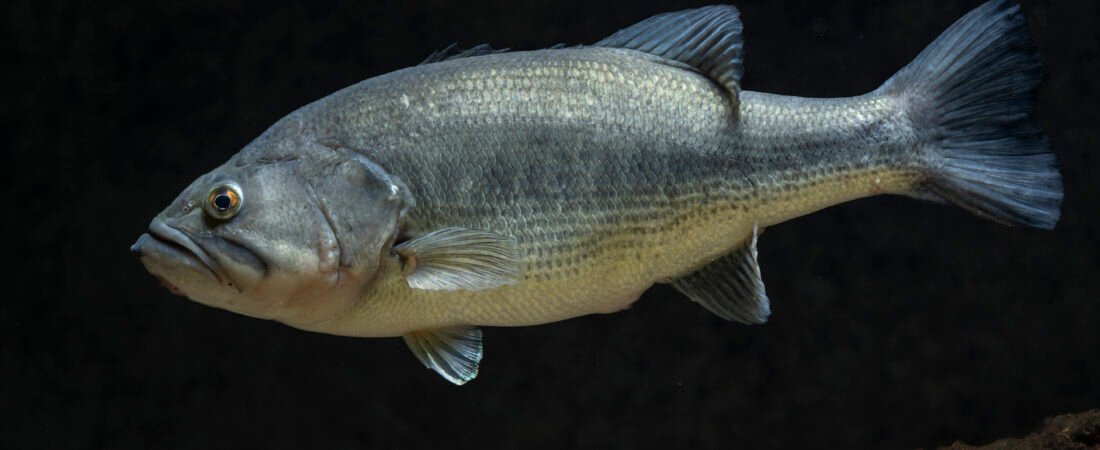
A baby largemouth bass starts life as a pinhead-sized amber egg, hatches into a nearly transparent fry about a quarter-inch long, and grows into a recognizable miniature bass, complete with a sharp, high-contrast lateral stripe, within roughly a month. By the time it reaches 2 inches, it already behaves like a small predator rather than a plankton feeder.

What Does a Largemouth Bass Egg Look Like?
A fertilized largemouth bass egg is small, round, and pale amber to yellowish in color, roughly the size of a pinhead, and adhesive enough to stick to the gravel, roots, and debris of the nest bottom rather than drifting freely. A single nest can hold thousands of eggs, deposited by a female and immediately fertilized by the guarding male, clustered together on the cleared nest substrate where the male can fan a steady current of oxygenated water over them and defend them from egg-eating fish until they hatch.
What Do Newly Hatched Largemouth Bass Fry Look Like?
Newly hatched fry are tiny, roughly 3 to 4 millimeters long, nearly transparent, and lack developed mouthparts or fins capable of independent swimming. For their first several days of life, they remain clustered on or near the nest bottom, living off the yolk sac still attached to their bodies rather than feeding externally. Basic mouthparts develop within about 18 hours of hatching, but the fry stay tethered to the nest, still guarded by the male, until that yolk sac is fully absorbed, typically one to two weeks after hatching depending on water temperature.
| Stage | Approximate Size | Appearance / Behavior |
|---|---|---|
| Egg | Pinhead-sized | Amber, adhesive, clustered on nest bottom |
| Newly hatched fry | 3-4 mm | Transparent, yolk-sac dependent, stays on nest |
| Swim-up fry | Roughly 1/4 in | Yolk sac absorbed, schools near surface, eats zooplankton |
| Early fingerling | Around 1.5 in (30-45 days) | Silvery, high-contrast juvenile stripe emerging |
| Fingerling | 4-6 in (about 4 months) | Feeds on small fish and invertebrates, adult-like shape |
When Does a Largemouth Bass Fry Start Swimming and Feeding on Its Own?
Once the yolk sac is absorbed, the fry enter what is known as the swim-up stage, rising off the nest bottom and forming a tight, visible school just under the surface, still under the guarding male’s protection. At this stage they begin feeding externally for the first time, targeting zooplankton small enough for their still-tiny mouths. Under favorable conditions, fry can grow at roughly 1 to 1.5 millimeters per day, reaching around an inch and a half within 30 to 45 days of hatching, the point at which the school typically begins to disperse and the male’s parental guarding duties come to an end.
What Does a Juvenile Largemouth Bass Look Like Compared to an Adult?
A juvenile largemouth bass shows the same basic body plan as an adult, an elongated body and the large, distinctive mouth, but with proportionally more silvery coloration and a noticeably sharper, higher-contrast lateral stripe than a mature fish typically displays. This crisp juvenile pattern is one reason very young largemouth bass are sometimes mistaken for spotted bass, since spotted bass carry a more finely broken, spot-like pattern that can superficially resemble a young largemouth’s still-developing markings. As the fish ages, the stripe tends to fade into the more blotchy, diamond-chained pattern typical of adults, and the overall coloration darkens from silvery toward the deeper olive-green tones covered in more depth elsewhere on this site.
How Can Anglers Tell a Baby Largemouth Bass From a Young Sunfish or Other Species?
The jaw is still the most reliable feature even on a small fish: a juvenile largemouth’s upper jaw already extends past the rear of its eye, a trait a young bluegill, crappie, or other sunfish will not share. Body shape is the second clue, a juvenile largemouth is more elongated and torpedo-shaped than the flatter, rounder profile of most young panfish. Anglers who catch a very small bass should also check local length and possession regulations before deciding whether to keep or release it, since many states set minimum length limits specifically to protect juvenile largemouth bass that have not yet reached spawning size, and releasing an undersized fish quickly and carefully gives it the best chance to reach maturity.
Frequently Asked Questions
What color are baby largemouth bass?
Newly hatched fry are nearly transparent. As they grow into fingerlings, they take on a silvery overall tone with a sharp, high-contrast lateral stripe that is more pronounced than the blotchier pattern seen on adults.
How big is a largemouth bass at one month old?
Roughly 1 to 1.5 inches under favorable conditions, having grown from a yolk-sac-dependent fry to a free-swimming, zooplankton-feeding fingerling in that time.
How can you tell a baby largemouth bass from a young sunfish?
Check the jaw and body shape. A juvenile largemouth’s upper jaw already extends past its eye, and its body is more elongated than the rounder, flatter profile typical of young sunfish like bluegill.
At what size does a juvenile largemouth bass start eating small fish?
Around 2 inches in length, when its diet and behavior shift from insects and zooplankton toward actively hunting small fish and crustaceans.