
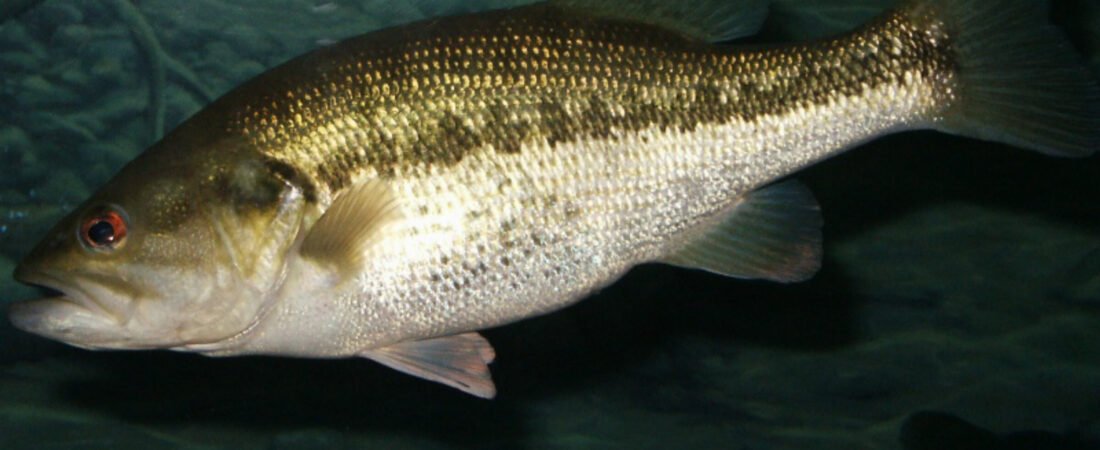
A largemouth bass typically gains about one pound of weight per year after its first year, though a fast-growing fish under ideal conditions can add two pounds or more in year one alone. Growth rate varies enormously by strain and climate, which is why a five-year-old northern-strain bass and a five-year-old Florida-strain bass can differ in weight by several pounds.

How Fast Does a Largemouth Bass Grow Each Year?
Growth is fastest early and slows with age. In its first year, a largemouth bass under favorable pond conditions can top 2 pounds, though roughly half a pound is more typical in natural lake and river systems with average forage availability. After that first year, most largemouth bass gain approximately one pound of body weight annually as long as forage stays adequate, though that rate tapers noticeably once a fish passes 5 to 6 pounds, since larger fish need proportionally more food to add the same amount of weight. Growth rate is driven primarily by water temperature, growing-season length, and forage abundance, three factors that also explain nearly all of the regional and strain variation described below.
| Age | Length | Weight |
|---|---|---|
| Age 1 | 6-8 in | 0.25-0.5 lb |
| Age 2 | 10-12 in | 0.75-1.25 lb |
| Age 3 | 12-14 in | 1.25-2 lb |
| Age 4 | 14-16 in | 2-3 lb |
| Age 5 | 15-17 in | 2.5-4 lb |
| Age 7 | 17-19 in | 4-6 lb |
| Age 10 | 19-21 in | 6-8 lb |
These figures represent a typical, well-fed northern-strain population and should be read as a general reference range rather than a fixed rule, since forage, water temperature, population density, and genetics can all push an individual fish well above or below these numbers at any given age.
How Much Faster Does Florida-Strain Largemouth Grow?
Growth rates between Florida-strain and northern-strain largemouth bass stay fairly close for the first few years of life, but the two diverge sharply from there. Florida-strain fish, and the F1 hybrid crosses produced by stocking Florida-strain males with northern-strain females, maintain an elevated growth rate well into later life stages rather than tapering off the way northern-strain fish typically do. Female Florida-strain bass are the ones capable of reaching truly exceptional size, with documented fish exceeding 20 pounds, while the maximum size for northern-strain largemouth tops out closer to 10 pounds even under excellent conditions. This is the core reason so many southern and western states deliberately stock Florida-strain fingerlings into reservoirs specifically to raise the trophy-size ceiling of a fishery, rather than relying on whatever strain a lake already holds.
What Actually Controls How Fast an Individual Bass Grows?
Four factors do almost all of the work. Water temperature and growing-season length set the ceiling on how many months per year a bass can feed and convert food into growth, which is the single biggest reason southern fish, of any strain, tend to reach a given size faster than northern fish of the same strain. Forage abundance determines whether that available growing time actually translates into weight gain, since a bass with abundant shad, sunfish, and crayfish nearby will convert calories into growth far more efficiently than one competing for scarce food. Population density matters too: a pond or lake with too many bass relative to its forage base produces a population of small, slow-growing, stunted fish regardless of strain or climate, since food gets spread too thin across too many mouths. Genetics, specifically strain, sets the outer ceiling on how large growth can ultimately take a fish, but genetics alone cannot overcome a poor growing season or an inadequate food supply.
Does Growth Rate Ever Slow Down or Stop?
Growth slows considerably with age but rarely stops entirely in a healthy fish. Annual weight gain that might be a pound or more in a bass’s early years can shrink to a few ounces a year once a fish reaches its late size range for its strain and environment, since metabolic cost per unit of additional growth rises as the fish gets larger. This is part of why the handful of fish that do reach truly exceptional trophy weights, in the 10-plus-pound range for Florida-strain fish especially, tend to be genuinely old individuals that have simply had more years to accumulate slow, incremental growth on top of an already favorable genetic and environmental starting point, rather than fish that grew unusually fast at any single point in their life.
Frequently Asked Questions
How much does a largemouth bass grow per year?
Roughly one pound per year after its first year under average conditions, though growth rate slows as the fish gets older and larger, and varies significantly by strain, climate, and forage availability.
How big is a one-year-old largemouth bass?
Typically 6 to 8 inches and a quarter to half a pound in an average natural water body, though a fish in an ideal, food-rich pond can exceed 2 pounds in its first year.
Do Florida-strain largemouth bass grow faster than northern-strain bass?
Growth rates are similar for the first few years, but Florida-strain fish maintain faster growth later in life, eventually reaching sizes well beyond the roughly 10-pound ceiling typical of northern-strain largemouth.
What determines how fast an individual largemouth bass grows?
Mainly water temperature and growing-season length, forage abundance, population density, and genetic strain. All four interact, and a strong genetic ceiling cannot overcome a poor food supply or a short growing season.