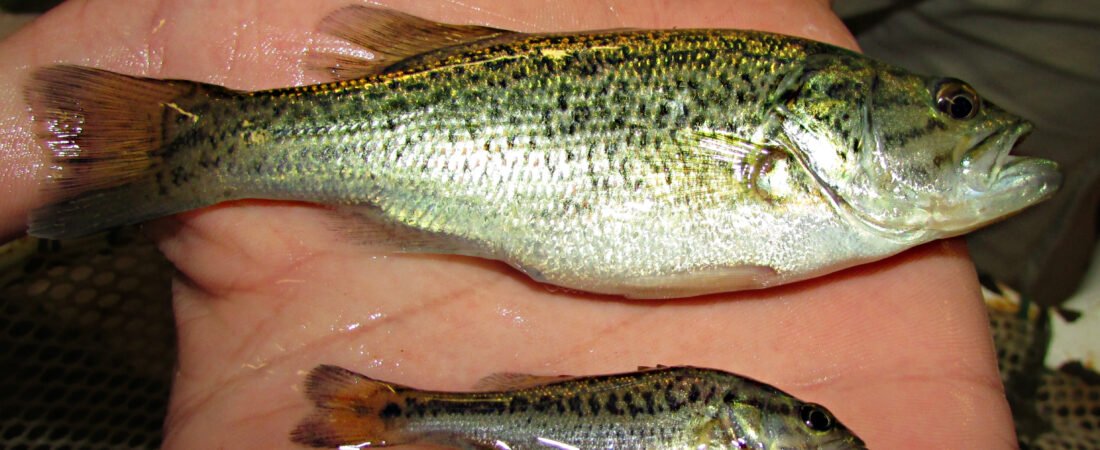
Largemouth bass are native to only about a third of the United States, the Mississippi basin, the Great Lakes region, and the Atlantic and Gulf coastal plains, yet stocking has established them in all 50 states and more than 50 countries on five continents. Almost everywhere an American angler fishes for largemouth bass today, the fish did not originally live there.

Where Are Largemouth Bass Actually Native To?
The species’ original range covers eastern and central North America: the Mississippi River basin, the St. Lawrence and Great Lakes drainage, the Red River basin draining into Hudson Bay, Atlantic Slope drainages from North Carolina south to Florida, and Gulf Coast drainages from southern Florida west into northern Mexico. That is a substantial footprint, but it leaves out large parts of the country, including most of the West, the interior Northeast, and the northern Plains, where every largemouth bass population alive today exists because of deliberate human introduction rather than natural range expansion.
How Did Largemouth Bass Spread Across the Rest of the US?
Stocking began in earnest in the mid-to-late 1800s, when adult fish were raised in outdoor hatchery ponds and their surviving fingerlings distributed elsewhere. The United States Fish Commission drove much of the early expansion, most notably shipping mixed batches of “black basses” to 29 states in a single year, 1893. That campaign, repeated and expanded by state fish commissions over the following decades, was remarkably effective: by 1900, largemouth bass had already become established in all of the lower 48 states, a stocking effort completed in barely a generation. Today the species is present in every continental US state and Hawaii, with even a single individual documented in Alaska as recently as 2018, though Alaska has no established wild population.
| Era | Milestone |
|---|---|
| Pre-1800s | Native to Mississippi basin, Great Lakes, Atlantic and Gulf coastal plains |
| 1870s-1890s | US Fish Commission begins wide-scale stocking; 1893 shipment to 29 states |
| By 1900 | Established in all of the lower 48 states |
| Late 1800s-1900s | First major international introductions begin |
| Present day | Established in 50+ countries on five continents |
Where Have Largemouth Bass Been Introduced Internationally?
Extensively, and on nearly every inhabited continent. Outside North America, largemouth bass are established in dozens of countries including Cuba, Guatemala, Honduras, Puerto Rico, Colombia, and Brazil in Latin America and the Caribbean; South Africa, Zimbabwe, and Kenya in Africa; Portugal, Spain, France, Germany, Italy, Hungary, Croatia, and Serbia across Europe; and Japan, the Philippines, Russia, China, South Korea, Fiji, and New Zealand across Asia and Oceania. Japan’s introduction is among the best documented internationally, since Lake Biwa, one of the country’s largest lakes, produced the fish that tied the all-tackle world record in 2009, a striking result given the species has been in Japan for less than a century compared with its far longer stocking history in the United States.
What Ecological Impact Has Introduction Had?
Mixed, and it depends heavily on where the introduction happened. Within their native North American range, largemouth bass are a well-integrated part of the ecosystem and a healthy, non-threatened sport fish. Outside that native range, especially in isolated island or freshwater ecosystems that evolved without a comparable predator, largemouth bass have in some documented cases reduced native fish populations through predation and competition, which is why a number of countries and regions have shifted from actively encouraging largemouth bass stocking to managing existing populations more cautiously, or in some cases attempting to control their spread, even as domestic demand for bass fishing as a sport continues to grow in many of those same places.
Frequently Asked Questions
Are largemouth bass native to the entire United States?
No. Their native range covers roughly the eastern and central US, the Mississippi basin, Great Lakes region, and Atlantic and Gulf coastal plains. Every population elsewhere in the US exists because of stocking.
When did largemouth bass become established in all 50 states?
Stocking efforts, driven heavily by the US Fish Commission starting in the 1870s-1890s, had established largemouth bass in all of the lower 48 states by 1900. Hawaii and other states followed later.
How many countries have largemouth bass been introduced to?
More than 50 countries across five continents, including nations in Latin America, Africa, Europe, and Asia, making it one of the most widely introduced freshwater gamefish in the world.
Are largemouth bass considered invasive anywhere?
Yes. In several countries outside their native North American range, wildlife agencies manage introduced largemouth bass populations as invasive due to documented impacts on native fish, even in places where the species is also prized as a sport fish.