
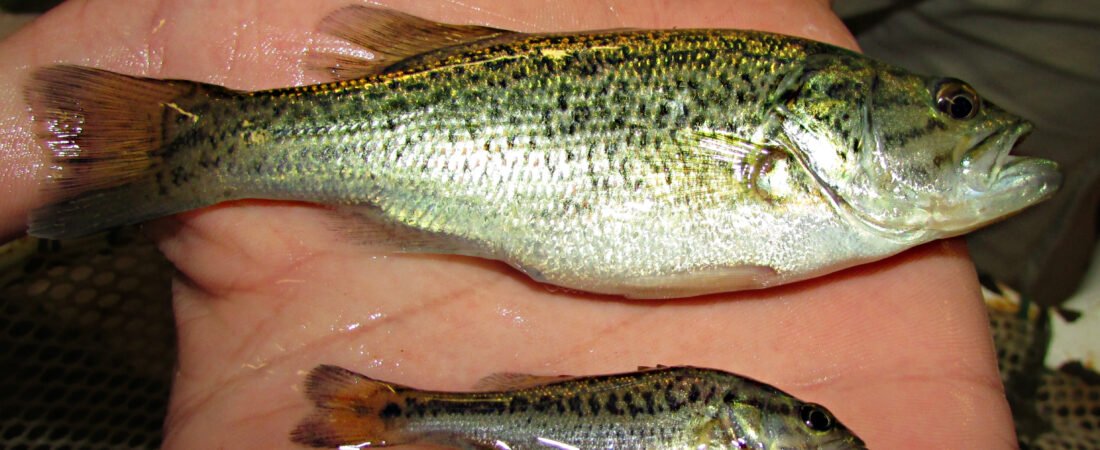
Largemouth bass hunt by holding motionless near cover and exploding outward in a fraction of a second, powered less by the jaw itself than by the whole body’s muscle driving a rapid suction strike. When and how often that strike happens depends heavily on light level, water temperature, and season, not just hunger.

How Does a Largemouth Bass Actually Strike Prey?
A bass strike is a whole-body event, not just a fast bite. Research into the mechanics of largemouth feeding has found that the axial body muscles running along the trunk, not the smaller muscles around the skull, supply most of the power behind a strike, meaning the fish is essentially launching its whole body forward while simultaneously executing a rapid suction-feeding motion. The mouth and gill cavity expand explosively to create negative pressure that pulls water, and the prey suspended in it, straight into the mouth, after which small, backward-angled teeth grip the catch so it cannot slip back out. This combination of burst-swimming power and suction feeding is what allows a bass to engulf prey nearly a third of its own body length in a single motion.
What Senses Does a Largemouth Bass Rely On While Hunting?
Largemouth bass layer multiple senses to locate and track prey. Vision matters most in clear, well-lit water, and bass have functional color vision with particular sensitivity to red and green wavelengths, a factor that shapes which lure colors tend to perform well in clear conditions. The lateral line, a row of fluid-filled sensory pores running along each side of the body, detects the pressure wave created by a moving or fleeing prey fish, letting a bass track and strike accurately even in muddy water or at night when vision alone would fail. Scent plays a supporting role too, particularly in stained or dark water where vibration and smell effectively take over as the primary hunting senses once light-based vision becomes unreliable.
Why Is “Ambush Predator” Not the Whole Story?
While largemouth bass are most often described as ambush hunters, that framing understates how much active positioning goes into the strategy. Rather than sitting in one fixed spot waiting indefinitely, bass actively select and periodically relocate to positions that maximize their odds of intercepting prey, adjusting to where baitfish are moving, where current or wind is pushing food, and where cover offers the shortest possible strike distance to a likely target. The ambush itself, the final explosive lunge, is brief, but the positioning that sets it up is a continuously active process rather than passive waiting.
When Are Largemouth Bass Most Active?
Feeding activity peaks during low-light, crepuscular periods, dawn and dusk, when temperatures are moderate and reduced light gives bass a predatory advantage over prey that relies more heavily on vision to detect danger. Many experienced anglers rate full darkness as an even more productive window than dawn or dusk, since bass are documented feeding more heavily at night than during almost any other period, particularly in summer when daytime heat pushes fish and forage into a lower-activity holding pattern until temperatures drop after sunset. Approaching weather can trigger a short, intense feeding spike as well, with bass often feeding aggressively just ahead of a storm system as barometric pressure begins to fall, then dropping off sharply once the pressure change and instability actually arrive.
How Does Water Temperature Affect Feeding Activity?
Metabolism, and therefore appetite, scales directly with water temperature within a bass’s tolerable range. Feeding activity climbs as water warms toward the upper 70s and low 80s Fahrenheit, the range where largemouth metabolism runs highest, then drops off in water that is either too cold, below the 60s, or uncomfortably hot, approaching 90 and beyond, both of which push a bass toward conserving energy rather than actively hunting. This is a major reason bass fishing success varies so much by season and even time of day within a season, since anglers are effectively trying to fish when a bass’s own metabolism says it should be feeding rather than resting.
Frequently Asked Questions
How fast is a largemouth bass strike?
Extremely fast, driven by the fish’s whole-body burst-swimming muscle rather than just the jaw, combined with an explosive suction motion that pulls prey and surrounding water directly into the mouth in a fraction of a second.
What senses do largemouth bass use to hunt?
Vision, including color vision sensitive to red and green, the lateral line for detecting prey movement by vibration, and scent, which becomes especially important in murky or dark water.
What time of day do largemouth bass feed most actively?
Dawn, dusk, and full darkness tend to see the most feeding activity, since low light gives bass a predatory advantage, with many anglers rating nighttime feeding as especially productive in summer.
Does water temperature affect how much largemouth bass eat?
Yes, significantly. Feeding activity rises as water warms into the upper 70s and low 80s Fahrenheit, largemouth’s metabolic sweet spot, and drops off in water that is too cold or too hot.