
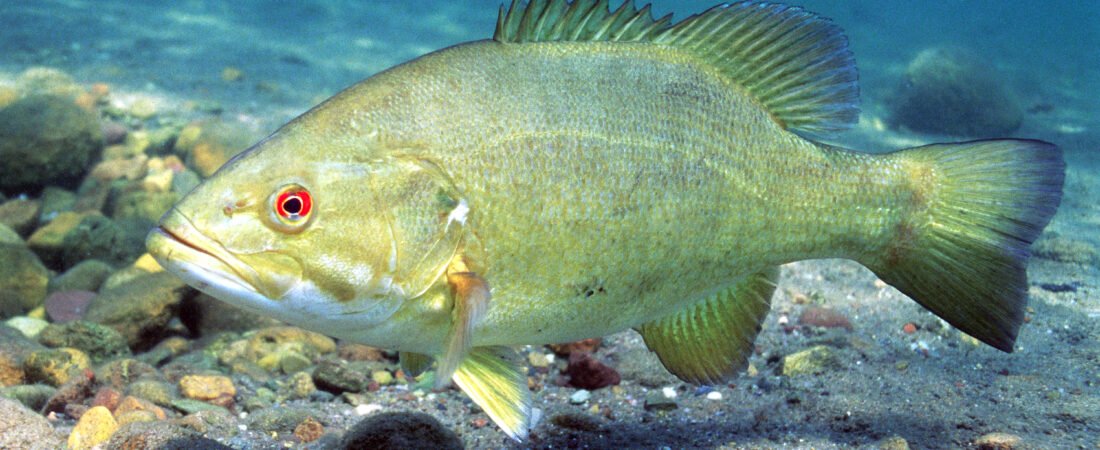
Largemouth bass favor warm, weedy, slow-moving water, while smallmouth bass favor cooler, clearer water with rock, gravel, or current. If a lake or river leans heavily toward one of those descriptions, that alone predicts which species you are more likely to find, often before a single cast.

Which Water Temperature Does Each Species Prefer?
Largemouth bass are the warm-water specialist of the pair, thriving in water in the upper 70s to mid-80s Fahrenheit and tolerating summer highs into the 90s far better than smallmouth can. Smallmouth bass prefer noticeably cooler water, generally most active in the mid-60s to mid-70s, and their metabolism and feeding activity drop off faster than a largemouth’s once water temperature climbs into genuinely hot summer ranges. This single difference explains much of why the two species dominate different water even within the same broad region: a shallow, sun-warmed farm pond favors largemouth by default, while a deep, spring-fed lake or a cold northern river favors smallmouth.
| Factor | Largemouth Bass | Smallmouth Bass |
|---|---|---|
| Preferred temperature | Upper 70s to mid-80s F | Mid-60s to mid-70s F |
| Water clarity | Tolerates murky, stained water well | Prefers clear water |
| Flow | Avoids fast current, favors sheltered slack water | Tolerates and often prefers moving current |
| Bottom type | Soft bottom, mud, sand with vegetation | Rock, gravel, cobble |
| Best water body type | Ponds, weedy lakes, slow rivers, reservoir coves | Rocky lakes, rivers, reservoir main-lake structure |
Why Does Vegetation Matter So Much More to Largemouth?
Largemouth bass are cover-oriented ambush predators, and submerged vegetation, fallen wood, and dock pilings function as both hunting cover and shelter from their own predators. A weedy, stained lake with a soft bottom and limited current gives largemouth exactly what they need: places to hide, slow-moving or schooling prey nearby, and water warm enough to support year-round activity. Smallmouth bass, by contrast, are built for open water and current, hunting more actively rather than relying purely on ambush, which is why they gravitate toward rock ledges, gravel bars, and current breaks rather than dense weed cover. A heavily vegetated lake with a soft, mucky bottom will rarely hold a strong smallmouth population even if the water is otherwise clean, simply because that habitat does not match how smallmouth hunt and live.
How Does Water Clarity and Current Change Which Species You’ll Find?
Largemouth bass tolerate murky, tannin-stained, or algae-tinted water far better than smallmouth do, since they hunt as much by vibration and lateral-line sensing as by sight and do not depend on spotting prey at distance the way a smallmouth does in open, clear water. Current is the other major divider: largemouth actively avoid fast-moving water, favoring backwaters, coves, and slack-water pockets even in river systems, while smallmouth are frequently described as primarily river fish, holding in and around current breaks and using moving water to their advantage when hunting. A river with strong, steady current and a rock or gravel bottom will typically favor smallmouth even if largemouth are also present somewhere in the system’s slower pools.
Can Both Species Thrive in the Same Lake?
Yes, and it is common in larger reservoirs and natural lakes that offer a mix of habitat types. In those systems, the two species typically segregate by zone rather than mixing randomly: largemouth concentrate in the shallower, weedier coves and creek arms, while smallmouth hold around deeper rock structure, points, and main-lake ledges. A lake that is uniformly one habitat type, all soft-bottomed and weedy, or all rocky and current-swept, will usually favor one species heavily over the other rather than supporting a strong population of both.
Frequently Asked Questions
Do largemouth and smallmouth bass prefer different water temperatures?
Yes. Largemouth bass thrive in warmer water, upper 70s to mid-80s Fahrenheit, while smallmouth bass prefer cooler water in the mid-60s to mid-70s range.
Why do smallmouth bass prefer rocky water and largemouth prefer weeds?
Largemouth are ambush predators that use vegetation and wood as hunting cover, while smallmouth are more active open-water hunters built for rock, gravel, and current, habitats where dense vegetation offers little advantage.
Can you find largemouth and smallmouth bass in the same lake?
Often, yes, particularly in larger reservoirs with mixed habitat. The two species typically sort by zone, largemouth in shallow weedy coves and smallmouth around deeper rock structure.
Which species tolerates murky water better?
Largemouth bass tolerate murky, stained water far better than smallmouth, which generally prefer clearer water and rely more on sight while hunting.