
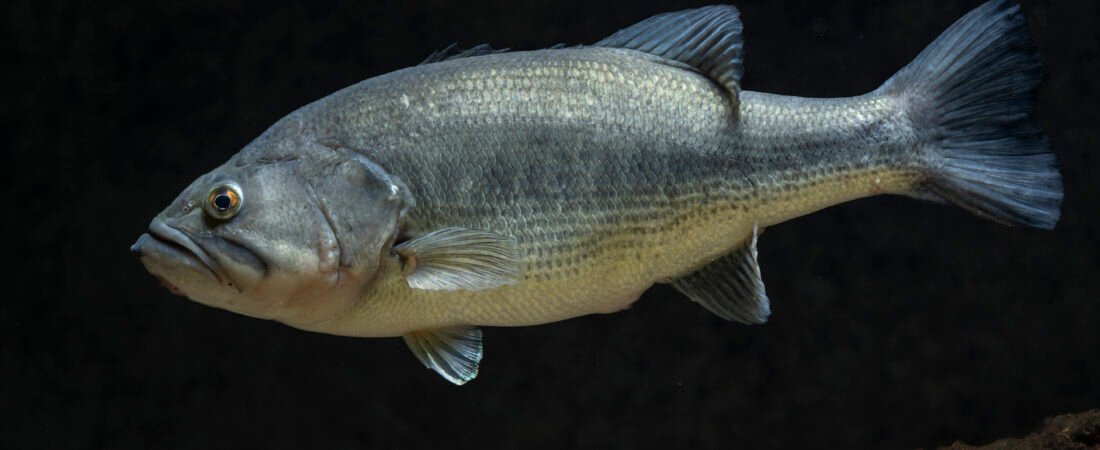
The fastest way to tell largemouth and smallmouth bass apart is the jaw: a largemouth’s upper jaw extends well past the eye, while a smallmouth’s stops at or before it. Beyond looks, the two species fight differently, feed differently, and respond to different lures, which matters as much to anglers as the identification itself.

What Are the Fastest Ways to Tell Them Apart?
Three visual cues settle the identification in seconds. The jaw is the most reliable: a largemouth’s upper jaw extends well past the rear edge of the eye, while a smallmouth’s ends at or before it. Color is the second cue, though less absolute since both species vary with habitat: largemouth run olive to dark green with a blotchy, broken horizontal stripe, while smallmouth run bronze to brown, often called “bronzebacks,” with faint vertical bars rather than a single lengthwise stripe. The dorsal fin is the third: a largemouth’s fin has a deep notch that nearly separates it into two fins, while a smallmouth’s fin has a shallow notch and reads as one continuous fin.
| Feature | Largemouth Bass | Smallmouth Bass |
|---|---|---|
| Jaw | Extends past the rear of the eye | Ends at or before the eye |
| Color | Olive green, blotchy stripe | Bronze, faint vertical bars |
| Dorsal fin | Deep notch, nearly two fins | Shallow notch, one continuous fin |
| Preferred water | Warm, weedy, slower water | Cool, clear, rocky or current-driven water |
| Typical fight | Powerful runs, aerial headshakes | Sustained jumps, often called the hardest-fighting freshwater fish pound for pound |
Which Species Fights Harder?
Pound for pound, most experienced anglers rate smallmouth bass as the harder fighter. A hooked smallmouth tends to go airborne repeatedly and fight with sustained energy through the whole retrieve, a reputation that has earned it a following among anglers who specifically target the species for the fight alone. Largemouth bass fight hard too, especially in the critical first few seconds after the strike, with a powerful initial run and violent headshakes, but they tend to tire and come to the boat more predictably once that first burst is spent. Neither species is objectively “better,” but the difference in fighting style is real enough that many anglers develop a strong preference for one over the other independent of size.
Do They Require Different Lures and Techniques?
Largemouth bass, as cover-oriented ambush feeders, respond best to presentations that can be worked through or around structure: soft plastics and creature baits flipped into weed edges and wood, spinnerbaits and chatterbaits burned along cover edges, and topwater lures worked over matted vegetation at dawn and dusk. Smallmouth bass, as open-water and current-oriented fish, respond better to presentations that mimic crayfish and baitfish in clear water: tube jigs and drop-shot rigs worked along rock and gravel bottoms, and crankbaits and jerkbaits that cover more open water than a largemouth angler typically needs to fish. An angler switching from a largemouth lake to a smallmouth river often has to downsize line and lures and slow down or speed up presentations to match the different forage and clearer water smallmouth prefer.
Which Species Grows Bigger?
Largemouth bass grow considerably larger. The all-tackle world record largemouth stands at 22 lb 4 oz, while the smallmouth bass world record is roughly 11.5 pounds, less than half that weight. A trophy largemouth in most waters starts around 8 pounds, while a trophy smallmouth is typically considered anything over 5 pounds, reflecting the two species’ genuinely different growth ceilings rather than just regional stocking differences.
Frequently Asked Questions
What is the easiest way to tell a largemouth from a smallmouth bass?
Check the jaw. A largemouth’s upper jaw extends well past the rear of its eye, while a smallmouth’s jaw ends at or before the eye. This single feature is more reliable than color, which varies with habitat in both species.
Which fights harder, largemouth or smallmouth bass?
Most experienced anglers consider smallmouth bass the harder fighter pound for pound, known for repeated jumps and sustained energy, while largemouth bass fight hardest in the first few seconds after the strike.
Do largemouth and smallmouth bass live in the same water?
Sometimes. Many larger reservoirs hold both species, typically sorted by depth and structure, with largemouth holding shallower near visible cover and smallmouth relating to deeper rock and current.
Which grows bigger, largemouth or smallmouth bass?
Largemouth bass, by a wide margin. The largemouth world record is 22 lb 4 oz, more than double the roughly 11.5 lb smallmouth bass world record.