
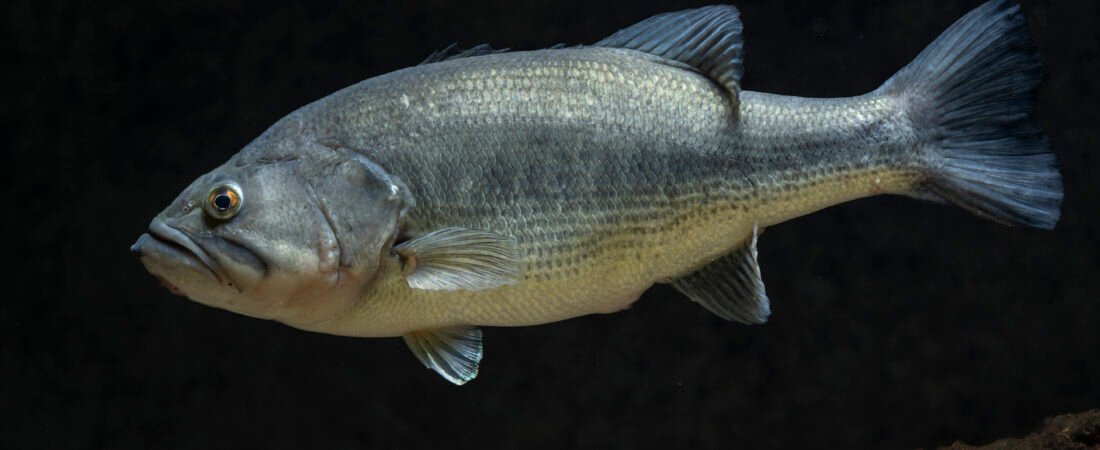
The all-tackle world record largemouth bass weighed 22 pounds, 4 ounces, caught by George Perry on June 2, 1932, in Montgomery Lake, Georgia. It stood alone for 77 years until Manabu Kurita caught an identical 22 lb 4 oz bass in Japan’s Lake Biwa in 2009, and IGFA rules now recognize both catches as co-record holders.

World Record Snapshot
How Did George Perry Catch the Original Record Bass?
Perry was a 19 or 20-year-old farmer in rural Georgia during the Great Depression, when fishing supplemented the family’s food supply as much as it served as recreation. On June 2, 1932, fields were too waterlogged from spring rain to work, so Perry and his friend Jack Page took a small homemade boat out on Montgomery Lake, an oxbow lake formed off the Ocmulgee River, sharing a single rod, reel, and lure between them. Perry hooked the fish on a Creek Chub Fintail Shiner, a wooden topwater lure. The bass measured 32.5 inches long with a 28.5-inch girth and weighed 22 pounds, 4 ounces on a store scale in the nearby town of Helena, Georgia, where the catch was witnessed and notarized.
Why Was Perry’s Fish Never Mounted or Photographed Being Weighed?
No photograph exists of the fish actually on the scale, and the only well-known image of the catch was taken later, holding the fish beside the crude wooden yardstick Perry used to measure it. The bass itself was never preserved: with no expectation that the catch would become a world record, and with food scarce during the Depression, Perry’s family simply cooked and ate the fish, reportedly serving it over the course of two dinners. The lack of a scale photograph has fueled decades of periodic skepticism and amateur re-investigation, though the notarized weight and measurements, along with Field & Stream’s subsequent recognition of the catch, have kept it standing as the official record.
How Long Did Perry’s Record Stand Before Being Matched?
Seventy-seven years. From 1932 until 2009, no verified catch anywhere in the world matched or exceeded Perry’s 22 lb 4 oz largemouth bass, despite the fish becoming the single most pursued record in freshwater sportfishing and drawing dedicated “record chasers” who spent entire fishing careers targeting waters believed capable of producing a bigger bass, most notably a handful of trophy lakes in Southern California stocked with Florida-strain largemouth specifically bred for size.
How Did Manabu Kurita Catch a Matching Record in Japan?
On July 2, 2009, Manabu Kurita, a 32-year-old angler from Aichi, Japan, was fishing Lake Biwa, the country’s largest lake, using a live bluegill as bait near a bridge piling. His bass weighed in at 10.12 kilograms, converting to exactly 22 pounds, 4 ounces, on certified scales, with a fork length of 27.2 inches and a girth of 26.7 inches. Largemouth bass are not native to Japan; they were introduced in the 20th century and have since become an established, and in Lake Biwa’s case controversial, invasive predator blamed for disrupting native fish populations.
How Did the IGFA Verify and Certify the Tie?
The International Game Fish Association, the body that has maintained official freshwater and saltwater world records since 1939, received Kurita’s application and supporting documentation on September 19, 2009. Verification included a polygraph examination of Kurita regarding the circumstances of the catch, a standard step IGFA uses for record claims of this significance, along with review of the scale certification, photographs, and witness statements. Kurita passed the examination, and the IGFA officially certified the catch. Under IGFA rules, a new all-tackle record must exceed the standing record by at least 2 ounces to replace it outright; because Kurita’s fish matched Perry’s weight exactly rather than beating it, the two catches were recognized as co-record holders rather than one replacing the other; an outcome that had never happened before at this level in the IGFA’s freshwater record books.

Why Is a Tie Different From a New Record?
The 2-ounce margin rule exists specifically to prevent record turnover based on scale measurement error or rounding rather than a genuinely larger fish, since certified scales still carry a small margin of uncertainty. Because Kurita’s bass landed at precisely the same certified weight as Perry’s rather than exceeding it by the required margin, IGFA rules classify it as tying the existing record rather than setting a new one. Both catches remain listed together in the IGFA record book to this day, and no fish has come close to either weight since 2009.
Frequently Asked Questions
What is the current world record largemouth bass?
22 pounds, 4 ounces, a weight shared by two catches: George Perry’s 1932 fish from Montgomery Lake, Georgia, and Manabu Kurita’s 2009 fish from Lake Biwa, Japan, officially recognized as co-record holders by the IGFA.
Why isn’t Kurita’s bass the new world record instead of a tie?
IGFA rules require a new all-tackle record to beat the standing record by at least 2 ounces. Kurita’s fish weighed the exact same as Perry’s, so it was certified as a tie rather than a replacement.
What happened to George Perry’s record-setting fish?
It was eaten. With no idea the catch would become a world record and food scarce during the Great Depression, Perry’s family cooked and ate the bass, so no mount or specimen of the original record fish exists today.
Are largemouth bass native to Japan, where the tying record was caught?
No. Largemouth bass were introduced to Japan in the 20th century and are now considered an invasive species in many Japanese lakes, including Lake Biwa, where Kurita’s record-tying fish was caught.