
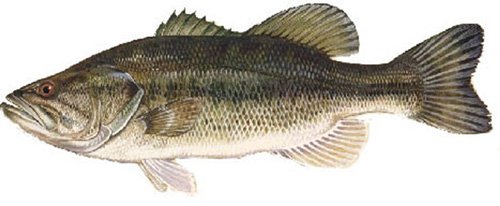
A male largemouth bass builds the nest, guards the eggs, and defends the fry almost entirely alone, a parenting job that can run three weeks or more and leaves him thin and exhausted by the end. The female’s role, by contrast, lasts only long enough to deposit her eggs before she leaves the nest for good.

Spawning Mechanics Snapshot
How Does a Male Largemouth Bass Choose and Build a Nest Site?
Nest-site selection is entirely the male’s job, and it is not random. He looks for shallow water, generally in the 1 to 4 foot range, close enough to cover such as weed edges, stumps, or dock pilings to offer some concealment while still leaving him a clear field of view to spot intruders. Once a site is chosen, he builds the nest by fanning his tail against the bottom, sweeping away a layer of soft muck and silt to expose a firmer surface, gravel, sand, root mat, or hard-packed mud, that eggs can adhere to and that will not smother them. The finished nest is a shallow, saucer-shaped depression roughly 2 to 3 feet across, swept clean of loose debris but often left with the harder bottom material, twigs, gravel, or shell fragments, that gave the male something firm to build on in the first place. Research on nest-site fidelity has found that males often return to the same general area to nest in following years when conditions were favorable, but tend to relocate to different, sometimes less ideal habitat after a failed or abandoned attempt.
What Happens During the Spawning Act Itself?
Once a nest is ready, the male attracts a female into the nest area, and the two circle and nudge one another in a courtship ritual before the female releases her eggs directly onto the cleared nest bottom. The male fertilizes the eggs as she releases them, and the process can repeat in bouts over a period of hours. A single female’s eggs may be distributed across nests with more than one male over the course of a spawning season, and a male’s nest may likewise receive eggs from more than one female, a mating pattern that spreads genetic diversity across a population rather than pairing fish into simple monogamous couples for the season. Once her eggs are deposited and fertilized, the female’s involvement ends immediately. She leaves the nest and takes no further part in guarding eggs or fry, a division of labor that puts the entire remaining reproductive workload on the male.
How Does a Male Largemouth Bass Guard the Nest?
Guarding is active and near-constant, not passive. The male continuously fans his fins over the eggs to keep a current of oxygenated water moving across them and to prevent silt and debris from settling and smothering the clutch, a task he repeats every few minutes throughout the entire incubation period. He also aggressively patrols the nest perimeter, striking at anything that approaches, sunfish, minnows, crayfish, other bass, and even harmless debris, since egg predators will move in within moments of an unguarded opportunity. Studies comparing guarded and unguarded nests found the difference in outcome to be dramatic: nests left unguarded lost a median of roughly 68 percent of their fry to predation, compared with a median loss around 14 percent when a male actively defended the site, making nest guarding one of the single most consequential parental behaviors in the species’ entire reproductive strategy.
What Happens After the Eggs Hatch?
Eggs typically hatch within 2 to 4 days of fertilization, with exact timing depending on water temperature, faster in warmer water, slower in cooler conditions. The newly hatched fry remain on the nest bottom for several more days, still guarded by the male, living off their yolk sac before they are developed enough to swim and feed independently. Once the fry become free-swimming, the male continues to guard the school as it hovers near the nest and gradually disperses outward, a period that can add another one to two weeks of active parental care. In total, a male’s guarding duties, from the moment eggs are laid to the point the fry finally scatter at around an inch in length, typically span one to three weeks, sometimes longer, during which he defends the school with the same aggression he showed toward the original nest.
What Does This Parental Effort Cost the Male Physically?
The toll is significant. A male largemouth bass on nest and fry duty for two to three weeks or more spends that entire period in a state of near-constant vigilance, frequently going long stretches without feeding since leaving the nest even briefly to hunt exposes the eggs or fry to predation. That sustained energy expenditure without proportional caloric intake leaves many males in noticeably poorer physical condition by the time guarding duties end, and fish that entered the spawning season already in weak condition are documented to be at real risk of dying during or shortly after this parental stretch. This energy debt is also part of why many anglers and biologists note a post-spawn lull, a period of reduced feeding activity across a lake’s bass population, as fish, particularly the males who just finished weeks of guarding, work to recover their condition before returning to a normal feeding pattern.
Frequently Asked Questions
Does the male or female largemouth bass guard the nest?
The male alone. The female leaves immediately after laying and fertilizing her eggs and takes no further part in guarding the nest, eggs, or fry.
How long does a male largemouth bass guard the fry?
Typically one to three weeks total, covering egg incubation, the days fry spend on the nest living off their yolk sac, and continued guarding after they become free-swimming until they disperse at around an inch long.
What happens to largemouth bass eggs if the male leaves the nest unguarded?
Predation losses rise sharply. Research comparing guarded and unguarded nests found a median fry loss around 68 percent when unguarded, compared with roughly 14 percent when a male actively defended the nest.
Does guarding the nest hurt the male largemouth bass?
Yes, often significantly. Extended guarding with little to no feeding leaves many males in noticeably poorer condition afterward, and fish that entered the spawn already weak are at real risk of dying during or after the guarding period.