
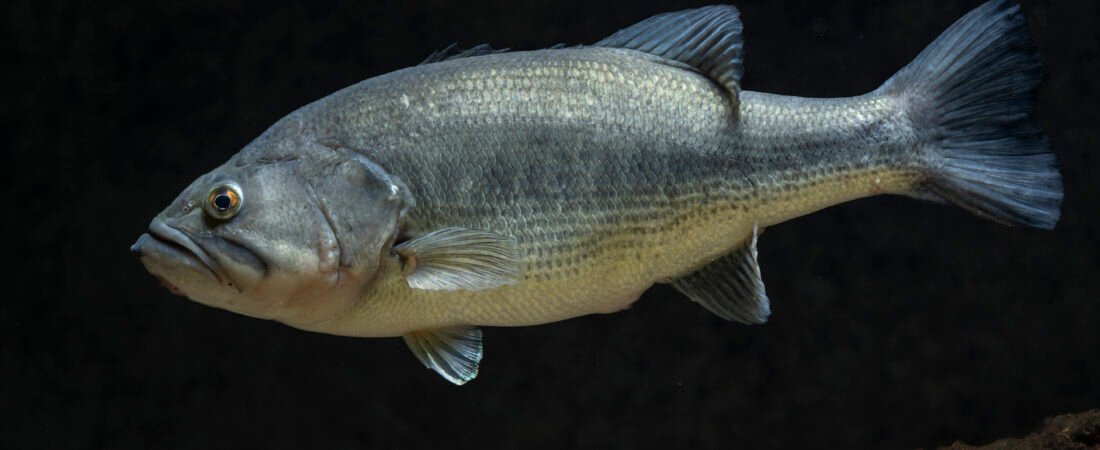
A largemouth bass does not simply bite its prey, it inhales it. In roughly 20 to 30 milliseconds, the fish snaps its mouth open, doubling its buccal cavity volume and creating a rush of inward water flow strong enough to suck a baitfish in before it can react. The jaw’s oversized reach is what lines the shot up; suction is what finishes it.

How Does a Largemouth Bass Actually Catch Prey With Its Mouth?
Largemouth bass are suction feeders, not biters. When a bass strikes, it rapidly expands its mouth and gill chambers, which drops the internal pressure below that of the surrounding water. Water, and whatever is floating in it, rushes into that low-pressure zone to equalize, carrying the prey into the bass’s mouth almost regardless of whether the fish’s jaws ever fully close around it first. The strike is less a snap and more a controlled implosion aimed at a single point in the water column, and the entire expansion happens in a fraction of a second, fast enough that a baitfish’s own escape reflex often cannot outrun the pressure wave it creates.
Mouth Mechanics Snapshot
What Powers the Suction, the Jaw or the Body?
Surprisingly, it is not the jaw muscles. Research using sonomicrometry on live largemouth bass found that the muscles most people would assume drive the strike, the ones that close the jaw, contribute almost none of the power behind the suction itself. Instead, the fish’s swimming muscles along its back and belly, the epaxial and hypaxial muscles, generate the bulk of the force. Those muscles pull on the skull and shoulder girdle in a way that rapidly expands the whole head, and the intricate arrangement of bones inside a bass’s mouth acts less like an active machine and more like the passive spokes of an umbrella, opening because the body’s swimming muscles are yanking the frame outward. This is part of why a bass in strong physical condition, with well-developed body muscle, can generate a noticeably more powerful strike than a smaller or weaker fish of similar jaw size.
Why Does the Upper Jaw Extend Past the Eye?
The jaw’s reach exists to maximize gape, the effective size of the opening the fish can create for a strike. A largemouth’s upper jaw, the maxilla, is only loosely bound to the skull and slides forward as the mouth opens, extending the reach of the strike beyond where a fixed jaw could manage. Combined with a mouth that can widen substantially side to side, this gives largemouth bass one of the largest gape-to-body-size ratios among North American freshwater predators, which is precisely why the jaw’s length past the eye became the single most reliable visual trait for identifying the species. A larger gape means a wider range of prey sizes and shapes the fish can physically engulf without having to bite or tear, which matters enormously for a fish that swallows prey whole rather than shredding it first.
How Big of a Meal Can a Largemouth Bass Actually Swallow?
Most prey taken by largemouth bass falls between 10 and 20 percent of the bass’s own body length, but the outer limit is dramatically higher. Field studies of ingested prey have recorded largemouth bass swallowing fish at 32 to 46 percent of their own total length, and anecdotal and documented cases push that figure as high as 60 to 70 percent in extreme instances, meaning a 15-inch bass is mechanically capable of engulfing prey close to a foot long under the right conditions. Prey that size takes real effort: the bass typically orients a fish prey item headfirst before swallowing, since a fish going down head-first folds its fins back naturally, while a tail-first attempt would force the fins to fight the swallowing motion the whole way down.
Does Gape Size Change as a Bass Grows?
Yes, and not always at the same rate as body length. Gape width tends to scale closely with overall body size, but the relationship is not perfectly linear across every stage of a bass’s life, since head and jaw proportions shift somewhat as a fish matures from a juvenile eating insects and zooplankton to an adult capable of taking full-grown sunfish. This is also part of why diet composition shifts so dramatically across a largemouth’s life, a fish’s realistic maximum prey size is a direct, physical consequence of how large its gape has become at that point in its growth, not simply a matter of appetite or aggression.
Frequently Asked Questions
Do largemouth bass bite or suck in their prey?
They suck it in. Largemouth bass are suction feeders that rapidly expand their mouth and gill chambers to create a pressure drop that pulls water and prey inward, rather than closing their jaws around prey the way a biting predator would.
What muscles power a largemouth bass’s strike?
Mostly the body-wall swimming muscles along the back and belly, not the jaw-closing muscles most people assume. Those muscles pull the skull and mouth open rapidly enough to generate the suction force behind the strike.
How big of a fish can a largemouth bass swallow?
Typically 10 to 20 percent of its own body length, though documented cases range up to 60 to 70 percent in extreme instances. The limiting factor is the prey’s body depth relative to the bass’s mouth width, not the prey’s overall length.
Why does a largemouth bass’s jaw extend past its eye?
A longer, sliding upper jaw increases the bass’s effective gape, letting it engulf a wider range of prey sizes through suction feeding. This trait is also the most reliable way to visually identify the species.