
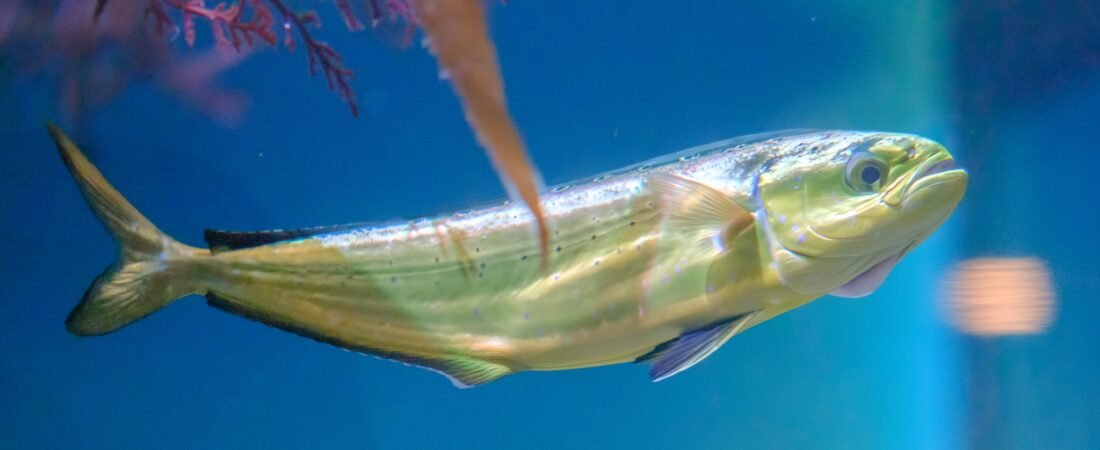
Mahi mahi gets called a lot of things by people who’ve never seen one alive: a dolphin, a tropical curiosity, sometimes just “that fish from the menu.” None of that answers the actual question. Biologically, mahi mahi is a specific, well-studied kind of fish with its own family, its own body plan, and traits that set it apart from almost everything else swimming in open water.
Here’s what mahi mahi actually is, working from the outside in: what kind of animal it is, what family it belongs to, and what its body is built to do.
A Bony Fish, Not a Mammal
Mahi mahi is a ray-finned bony fish (class Actinopterygii), the same broad group that includes the vast majority of fish species on Earth. It breathes through gills, is cold-blooded, and lays eggs rather than giving live birth. That matters because the name “dolphinfish” leads a lot of people to assume a relation to actual dolphins, which are warm-blooded, air-breathing marine mammals with no biological connection to mahi mahi at all. The two share nothing but an old nickname and a habit of swimming near the surface.
Its Place in the Fish Family Tree
Mahi mahi belongs to the order Carangiformes, a classification that’s newer than most people realize. For decades, mahi mahi was grouped in the much larger order Perciformes, a catch-all that held a huge share of ray-finned fish. Molecular studies over the past decade untangled that grouping using genetic data instead of just physical resemblance, and mahi mahi was moved into Carangiformes, the order that also contains jacks, trevallies, and other fast, open-water hunters. It’s a more accurate home for a fish built the way mahi mahi is.
Within that order sits the family Coryphaenidae, one of the smallest fish families in existence. It contains exactly two species: mahi mahi (Coryphaena hippurus) and its smaller relative, the pompano dolphinfish (Coryphaena equiselis). No other fish on Earth belongs to this family.
Quick Classification
A Body Built for Open Water
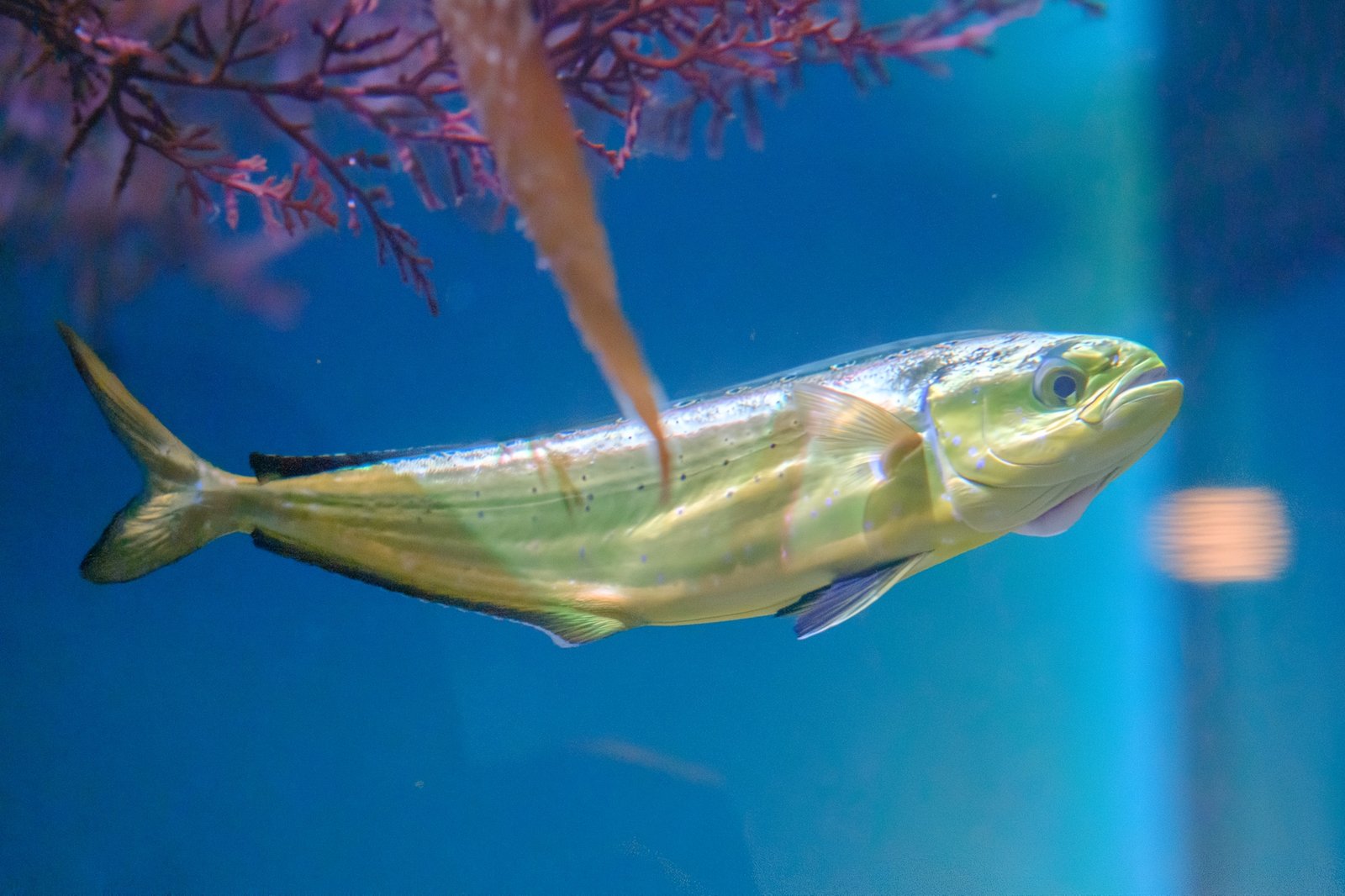
Mahi mahi is pelagic, meaning it lives in the open water column rather than near reefs or the seafloor. Its body reflects that lifestyle in specific, measurable ways. The dorsal fin is unusually long, running from just behind the head almost to the tail with 52 to 66 soft rays, more than almost any comparably sized fish. The anal fin mirrors it along the bottom with another 23 to 30 rays. Small, tightly embedded cycloid scales keep drag to a minimum, and the lateral line, the sensory organ fish use to detect movement and pressure changes in the water, curves upward above the pectoral fin before running straight to the tail.
The mouth is large and lined with bands of fine teeth suited to grabbing fast-moving prey like flying fish rather than crushing shellfish or grazing algae. None of these features are decorative. Every one of them serves a fish that spends its life hunting at speed in open water with nowhere to hide and nothing to hide behind.
Why “Fish” Is the Whole Answer
It’s worth stating plainly, because the naming confusion runs deep: mahi mahi is not a dolphin, not a shark, and not related to either. It’s simply a fish, classified alongside jacks and trevallies, built for one purpose that its entire anatomy reflects. The name confusion has its own long history, covered in more detail in the article linked below.
The short version: mahi mahi is a fast, pelagic, ray-finned fish in a two-species family, and every part of its body, from the oversized dorsal fin to the streamlined scales, is built around speed in open water.
Explore the rest of the Mahi Mahi series
Biology & Identification
- Mahi Mahi: Full Species Overview
- Why Male Mahi Mahi Have That Distinctive Flat Forehead
- Bull vs Cow Mahi Mahi: How to Tell the Male and Female Apart
- Why Mahi Mahi Changes Colour: The Blue, Gold, and Green Explained
- Why Is Mahi Mahi Called Dolphinfish? The Name Confusion Explained
- Other Names for Mahi Mahi: Dorado, Dolphinfish, and Why It Has So Many
- Mahi Mahi Scientific Name: Coryphaena Hippurus and Its Taxonomy Explained
- Mahi Mahi Facts: 10 Things Most People Do Not Know
Habitat & Behavior
- Mahi Mahi Spawning and Reproduction: How They Breed and How Fast They Grow
- How Long Do Mahi Mahi Live? Lifespan, Growth Rate, and Maturity
- What Eats Mahi Mahi? Natural Predators in the Ocean
- How Fast Can Mahi Mahi Swim? Speed, Agility, and Why They Are Hard to Land
- What Do Mahi Mahi Eat? Diet, Prey, and Feeding Habits in the Wild
- Mahi Mahi in the Atlantic vs Pacific: Are They the Same Fish?
- Mahi Mahi Migration: How They Follow Warm Currents Around the World
- Mahi Mahi Habitat: Why They Hang Around Sargassum and Floating Debris
- Where Do Mahi Mahi Live? Ocean, Depth, and Temperature Preferences
- Baby Mahi Mahi: Should You Release Juvenile Mahi and How to Identify Them
Size & Records
- How Big Do Mahi Mahi Get? Size, Weight, and World Record
- Mahi Mahi World Record: Biggest Ever Caught and Where
Food & Health
- Fresh vs Frozen Mahi Mahi: Does It Make a Difference?
- Wild-Caught vs Farmed Mahi Mahi: What Is the Difference?
- Is Mahi Mahi a Sustainable Seafood Choice?
- Fish Similar to Mahi Mahi: What to Buy When It Is Not Available
- Mahi Mahi vs Tuna, Salmon, and Grouper: How Does It Compare?
- Can Dogs Eat Mahi Mahi? What Is Safe and What to Watch Out For
- Is Mahi Mahi Safe to Eat During Pregnancy? Mercury and Safety Explained
- Mahi Mahi Mercury Levels: Is It Safe and How Often Can You Eat It?
- Is Mahi Mahi Good to Eat? What Makes It One of the Most Popular Fish
- Mahi Mahi Nutrition Facts: Protein, Omega-3, Calories, and Vitamins
- Is Mahi Mahi a White Fish? Flesh Colour, Texture, and How It Compares
- What Does Mahi Mahi Taste Like? Flavour, Texture, and Is It Fishy?
- Mahi Mahi Population: Are Numbers Healthy and Is Overfishing a Risk?
- Mahi Mahi and Bycatch: What Gets Caught Alongside It and Why It Matters
Fishing
- Mahi Fishing Tips: Rigs, Trolling Speeds, and What Actually Works
- How to Catch Mahi Mahi: Techniques, Tackle, and Where to Find Them
- Mahi Mahi Fishing: Everything You Need to Know to Find and Catch Them
- Mahi Mahi Fishing in Florida: Season, Hotspots, and How to Catch Them
- Where to Catch Mahi Mahi: Best Locations Around the World
- Mahi Mahi Fishing Charters: What to Expect and How to Choose One
- Mahi Mahi Season: When and Where to Fish for Peak Action
- Best Lures for Mahi Mahi: What They Strike and Why
- Trolling for Mahi Mahi: Speed, Spread, and Setup Explained
- Finding Mahi Mahi on Sargassum Lines: Why Weed Lines Are the Key
- Mahi Mahi Fishing in Hawaii: When to Go and What to Expect