
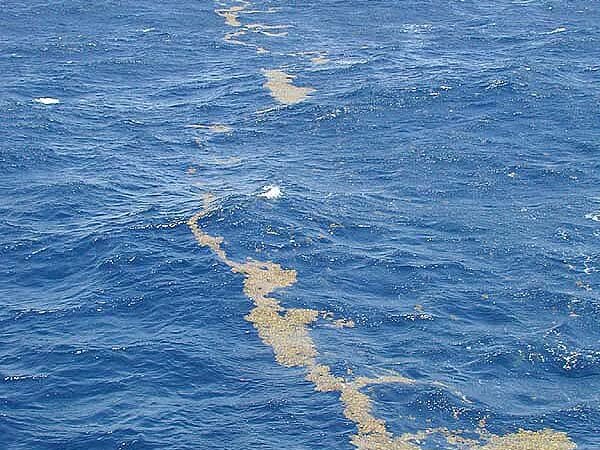
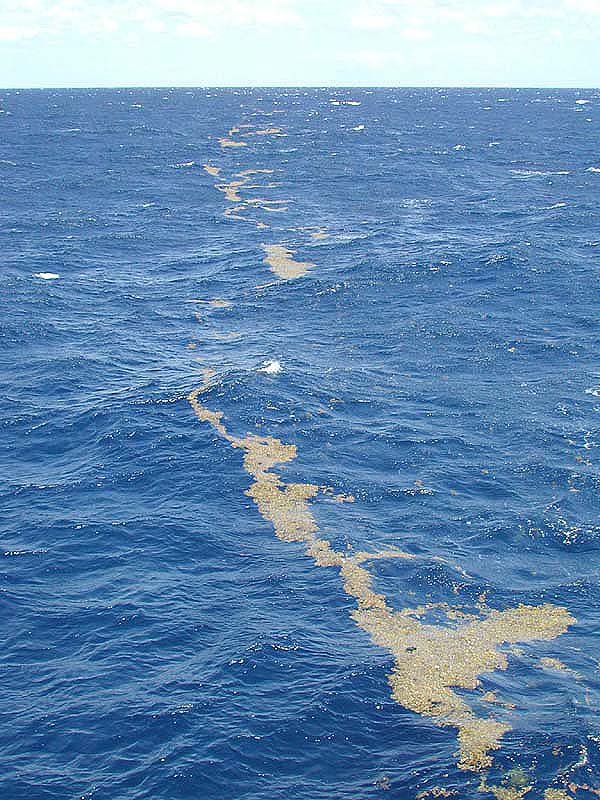
Finding fishable weed involves reading four visual cues from the boat: a distinct color change where blue and green water meet, unbroken lines or clumps of sargassum riding that seam, diving or circling frigatebirds and terns overhead, and floating debris tangled into the weed itself. Working the edge of that line rather than crossing straight over it is what turns a spotted weed line into hooked fish.
Sargassum’s role as biological habitat for mahi mahi is well established elsewhere. This piece is about the practical side: how to actually spot a productive weed line from the helm and fish it once you’re on it.
The Color Change Is the First Thing to Look For
Long before individual clumps of weed become visible, a sharp color change on the surface is usually the first sign something is holding fish. Clean blue offshore water meeting greener, more turbid water creates a visible seam, and that seam is where current shear concentrates both drifting sargassum and the baitfish riding along with it. Polarized sunglasses make this edge far easier to pick out from a distance, cutting surface glare enough to reveal a color line that would otherwise blend into open water from more than a few hundred yards out. Running the boat along a color change, even before any weed is visible, is often a more efficient search pattern than randomly crossing open water hoping to stumble onto a line.
Not every color change holds fish
Tide lines and river outflow edges can create a visible color change without meaningful current shear behind them. A productive line usually shows debris or weed actually collecting along the seam, not just a color difference with nothing riding on it.
Reading the Weed Line Itself
Once weed is visible, not all of it fishes the same. A long, continuous line of sargassum, sometimes stretching for miles, tends to hold fish spread out along its entire length, while isolated clumps or patches concentrate fish more tightly in a smaller area. Denser mats generally outfish thin, scattered weed, since more surface structure means more shelter for the baitfish mahi mahi are actually keying in on. The edges of a mat, rather than its thickest interior, are typically the most productive water to work, since baitfish tend to hold along the margins where they can dart back into cover, and mahi mahi patrol those same margins looking for exactly that opportunity.
Let the Birds Do Some of the Searching
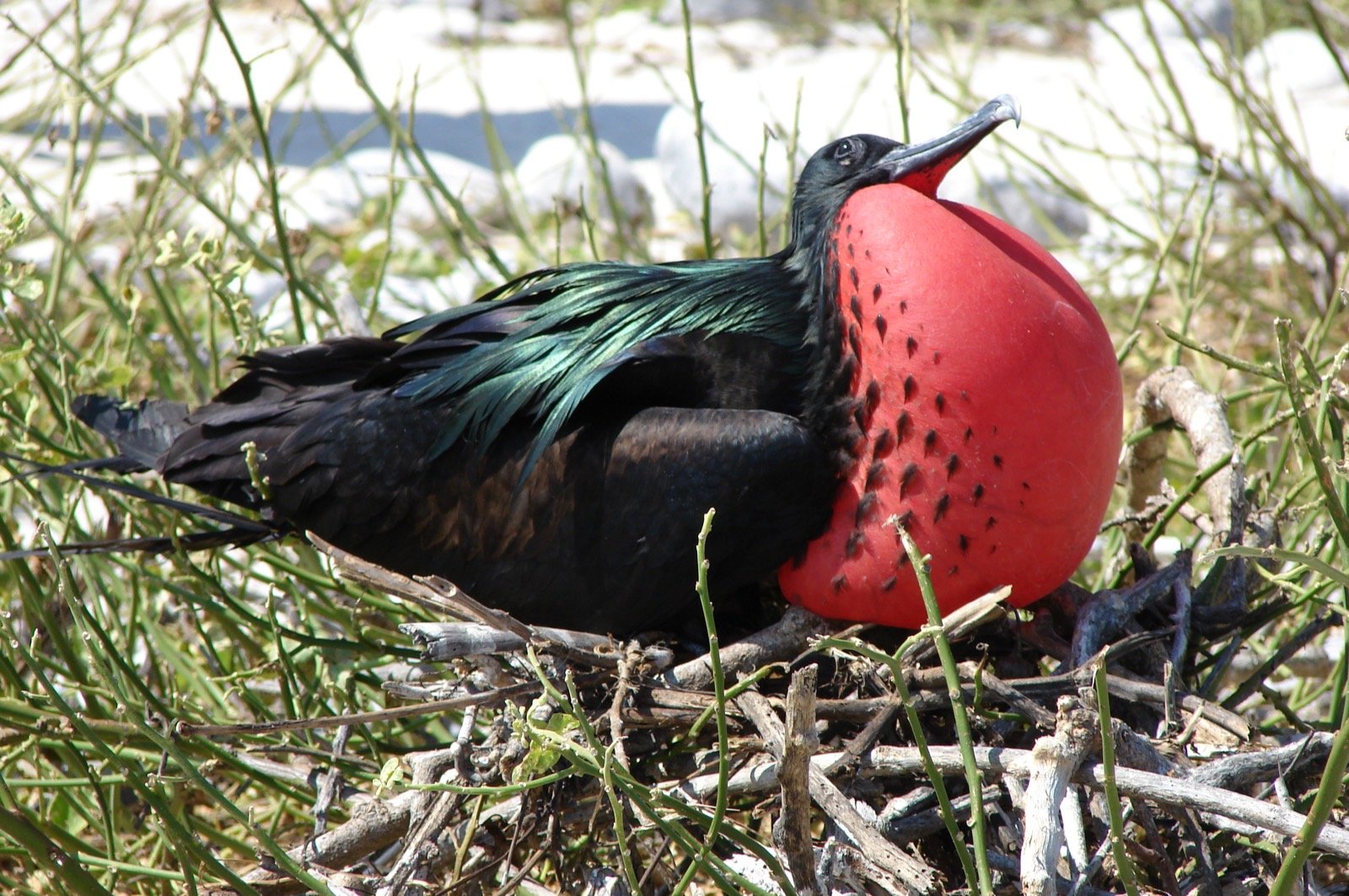
Frigatebirds and terns feed on the same baitfish mahi mahi are hunting, and circling or diving birds are one of the most reliable visual cues available from the helm, sometimes visible from far greater distances than the weed or color change itself. Frigatebirds in particular tend to hover and circle patiently over active bait rather than diving immediately, a behavior worth learning to recognize since it often signals sustained feeding activity below rather than a one-off strike. Scanning the horizon with binoculars periodically, not just watching the water directly ahead of the boat, catches bird activity that would otherwise be missed entirely on a longer run between spots.
Debris Beyond Sargassum Works the Same Way
Sargassum isn’t the only visual cue worth chasing. Driftwood, pallets, rope, buoys, and other floating debris trigger the same baitfish-concentration effect as weed, and a floating object with birds working around it should be treated with the same seriousness as a proper weed line. Man-made FADs, fish aggregating devices some fisheries deploy specifically to concentrate pelagic species, are a more reliable, repeatable version of the same principle, and captains who fish a region regularly often keep a running list of known FAD or debris locations worth checking even when nothing is visible on the surface that day.
How to Actually Work a Weed Line Once You’re On It
The approach matters as much as finding the line in the first place. Running parallel to a weed edge, rather than straight through the middle of it, keeps lures in clean water instead of fouling them in loose weed, and it lets the spread pass repeatedly along the most productive water rather than crossing it once and moving on. Making at least two or three passes along a promising stretch before writing it off is generally worth the time, since fish holding deeper in a mat don’t always react to the first pass, especially in slower-moving current. Watching for any surface activity, tails, splashes, or bait skipping away from something underneath, while making a pass gives an early signal to slow down and work that specific stretch more carefully rather than continuing straight through.
| Visual Cue | What It Signals | Best Response |
|---|---|---|
| Color change / current seam | Bait concentration along a shear line | Run the seam, watch for weed or debris |
| Dense, continuous weed line | Sustained baitfish shelter | Work the edges with multiple passes |
| Circling / diving birds | Active feeding below the surface | Approach and pitch baits toward activity |
| Isolated debris or FAD | Localized bait concentration | Slow down, work the immediate area thoroughly |
Sun Angle Changes How Well You Can See
Spotting a color change or a weed line from the helm depends heavily on sun position, and the same stretch of ocean can look completely different depending on the hour. Mid-morning to early afternoon, with the sun higher overhead, generally offers the clearest visibility into the water and the sharpest read on color changes and subsurface weed. Early morning and late afternoon runs, with the sun low on the horizon, can wash out visibility when running into the glare, so adjusting course to keep the sun at an angle rather than dead ahead, even if it means a slightly longer run, often pays off in how much more gets spotted along the way.
Using Water Temperature Alongside What You See
Visual cues work best paired with a water temperature gauge rather than relied on alone. A color change or weed line sitting in water that’s still too cool, below roughly 68 degrees Fahrenheit, is far less likely to hold mahi mahi even if it looks visually promising. Watching the temperature gauge climb as the boat crosses a seam confirms that a spotted color change is actually a warm-water edge worth working, rather than just a visual difference with no real current shear behind it. Many captains treat a rising temperature reading combined with a visible seam as a stronger signal to slow down than either cue alone would provide.
Equipment That Makes Spotting Easier
A handful of tools make the difference between spotting structure from a few hundred yards and missing it entirely. Quality polarized sunglasses cut surface glare enough to reveal color changes and subsurface weed that would otherwise blend into open water. Binoculars extend the effective search radius well beyond what’s visible to the naked eye, particularly useful for catching bird activity on the horizon. An elevated helm position or tower, where available, adds a meaningfully wider field of view than fishing from deck level, which is part of why towers are standard equipment on boats that fish sargassum-heavy regions seriously.
Adjusting the Search Pattern as the Day Progresses
A single productive weed line spotted early in a trip is often worth returning to later, since sargassum drifts with current rather than staying fixed in place, and marking its GPS position lets a boat run a wider search pattern before circling back if the first pass doesn’t produce. On days with genuinely little visible structure, working a zig-zag pattern across a likely current seam, rather than running a straight line, covers more of the seam’s length and improves the odds of crossing a weed line or debris field that a direct route would have missed entirely. Patience during the search phase generally pays off more than rushing to cover maximum distance, since a slower, more attentive pass is far more likely to catch a subtle color change or a distant bird than a fast run focused only on ground covered.
Mistakes That Cost Fish on a Weed Line
The most common mistake is running the spread straight through the thickest part of a mat instead of along its edge, fouling lures in weed within seconds of reaching a promising line. A close second is abandoning a line too quickly after one unproductive pass, particularly on slower-moving weed that fish may still be actively working even without an immediate strike. Scanning only the water directly ahead of the boat, rather than periodically checking the horizon with binoculars for birds or a color change farther out, also means missing productive water that a wider search pattern would have caught.
Finding mahi mahi on structure comes down to reading the ocean’s surface for a handful of specific signals, a color seam, weed density, bird activity, and debris, then working that structure’s edges patiently rather than crossing it once and moving on.
Frequently Asked Questions
What’s the fastest way to spot a productive weed line?
Watching for a color change where blue water meets greener water, then scanning that seam for weed, debris, or circling birds, is generally faster than randomly searching open water.
Should I fish the middle or the edge of a sargassum mat?
The edges. Baitfish tend to hold along the margins of a mat where they can dart back into cover, and mahi mahi patrol those same edges rather than the densest interior.
Do birds always mean fish are present?
Not always, but circling or diving frigatebirds and terns are one of the more reliable visual cues available, since they’re feeding on the same baitfish mahi mahi are hunting below.
Does time of day affect how easily a weed line can be spotted?
Yes. Mid-morning to early afternoon with the sun higher overhead generally offers the clearest visibility, while low sun angles at dawn and dusk can wash out visibility when running into the glare.
How is this different from why mahi mahi like sargassum in the first place?
The biology behind why sargassum attracts mahi mahi, as a feeding ground and juvenile nursery, is covered in a separate article. This one focuses specifically on the practical, on-the-water skill of spotting and working a weed line once you’re looking for fish.
Explore the rest of the Mahi Mahi series
Biology & Identification
- Mahi Mahi: Full Species Overview
- Why Male Mahi Mahi Have That Distinctive Flat Forehead
- Bull vs Cow Mahi Mahi: How to Tell the Male and Female Apart
- Why Mahi Mahi Changes Colour: The Blue, Gold, and Green Explained
- Why Is Mahi Mahi Called Dolphinfish? The Name Confusion Explained
- Other Names for Mahi Mahi: Dorado, Dolphinfish, and Why It Has So Many
- Mahi Mahi Scientific Name: Coryphaena Hippurus and Its Taxonomy Explained
- What Kind of Fish Is Mahi Mahi? Classification, Family, and Biology
- Mahi Mahi Facts: 10 Things Most People Do Not Know
Habitat & Behavior
- Mahi Mahi Spawning and Reproduction: How They Breed and How Fast They Grow
- How Long Do Mahi Mahi Live? Lifespan, Growth Rate, and Maturity
- What Eats Mahi Mahi? Natural Predators in the Ocean
- How Fast Can Mahi Mahi Swim? Speed, Agility, and Why They Are Hard to Land
- What Do Mahi Mahi Eat? Diet, Prey, and Feeding Habits in the Wild
- Mahi Mahi in the Atlantic vs Pacific: Are They the Same Fish?
- Mahi Mahi Migration: How They Follow Warm Currents Around the World
- Mahi Mahi Habitat: Why They Hang Around Sargassum and Floating Debris
- Where Do Mahi Mahi Live? Ocean, Depth, and Temperature Preferences
- Baby Mahi Mahi: Should You Release Juvenile Mahi and How to Identify Them
Size & Records
- How Big Do Mahi Mahi Get? Size, Weight, and World Record
- Mahi Mahi World Record: Biggest Ever Caught and Where
Food & Health
- Fresh vs Frozen Mahi Mahi: Does It Make a Difference?
- Wild-Caught vs Farmed Mahi Mahi: What Is the Difference?
- Is Mahi Mahi a Sustainable Seafood Choice?
- Fish Similar to Mahi Mahi: What to Buy When It Is Not Available
- Mahi Mahi vs Tuna, Salmon, and Grouper: How Does It Compare?
- Can Dogs Eat Mahi Mahi? What Is Safe and What to Watch Out For
- Is Mahi Mahi Safe to Eat During Pregnancy? Mercury and Safety Explained
- Mahi Mahi Mercury Levels: Is It Safe and How Often Can You Eat It?
- Is Mahi Mahi Good to Eat? What Makes It One of the Most Popular Fish
- Mahi Mahi Nutrition Facts: Protein, Omega-3, Calories, and Vitamins
- Is Mahi Mahi a White Fish? Flesh Colour, Texture, and How It Compares
- What Does Mahi Mahi Taste Like? Flavour, Texture, and Is It Fishy?
- Mahi Mahi Population: Are Numbers Healthy and Is Overfishing a Risk?
- Mahi Mahi and Bycatch: What Gets Caught Alongside It and Why It Matters
Fishing
- Mahi Fishing Tips: Rigs, Trolling Speeds, and What Actually Works
- How to Catch Mahi Mahi: Techniques, Tackle, and Where to Find Them
- Mahi Mahi Fishing: Everything You Need to Know to Find and Catch Them
- Mahi Mahi Fishing in Florida: Season, Hotspots, and How to Catch Them
- Where to Catch Mahi Mahi: Best Locations Around the World
- Mahi Mahi Fishing Charters: What to Expect and How to Choose One
- Mahi Mahi Season: When and Where to Fish for Peak Action
- Best Lures for Mahi Mahi: What They Strike and Why
- Trolling for Mahi Mahi: Speed, Spread, and Setup Explained
- Mahi Mahi Fishing in Hawaii: When to Go and What to Expect