
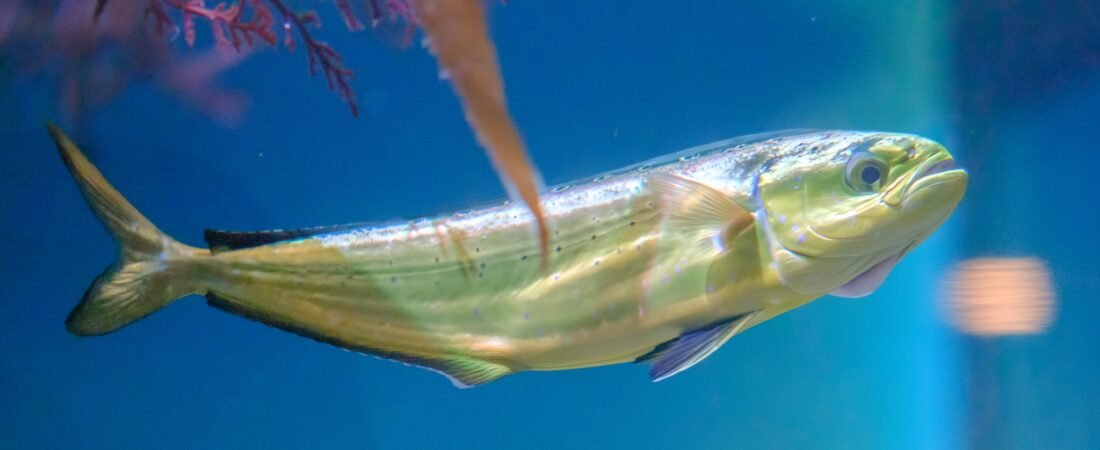
The details that actually move the needle on a mahi mahi trip: troll at 6 to 8 knots rather than wahoo-speed 12 to 16, rig ballyhoo with half the bill left on for stability at that speed, and skip treble hooks on trolled baits since they tangle in the skirt and kill the bait’s action. None of these are secrets, but skipping them is exactly what separates a slow day from a full box.
Here are the specific rigging details, speed numbers, and common mistakes that make the real difference.
Get the Trolling Speed Right
Mahi mahi respond best to a trolling speed of 6 to 8 knots, noticeably slower than the 12 to 16 knots used for wahoo. That speed range lets most lure types track properly and keeps rigged ballyhoo intact rather than tearing apart or spinning unnaturally. Running too fast is one of the most common mistakes anglers make when a wahoo-focused spread doesn’t produce mahi in water that should be holding them.
Rig the bill correctly for your speed
Keep half the ballyhoo’s bill intact for standard 6-8 knot trolling, the remaining stub helps stabilize the bait’s action. Remove the bill entirely only when trolling faster, at 10 knots or more.
Skip treble hooks on trolled ballyhoo
Treble hooks tangle easily in the skirt material and disrupt the bait’s swimming action. A single hook connected via snell knot, crimp sleeve, or haywire twist keeps the presentation clean.
Don’t overpower small baits
Oversized marlin-class chuggers on a standard ballyhoo overpower the bait and cause porpoising, an unnatural skipping motion that spooks fish rather than attracting them. Match lure size to bait size.
Add a Dredge to Raise More Fish
Dredges work on mahi mahi for the same reason they work on marlin, sailfish, and tuna: the dense visual of a simulated bait ball triggers a strong predatory response. A 12-ounce dredge weight runs a standard squid dredge at roughly 10 to 15 feet deep at 6 knots, while stepping up to 24 ounces pushes it to 15 to 25 feet, useful for working different parts of the water column depending on where fish are holding.
| Setup | Detail |
|---|---|
| Trolling speed | 6-8 knots |
| Ballyhoo bill (6-8 kt) | Half intact |
| Ballyhoo bill (10+ kt) | Removed entirely |
| 12 oz dredge depth | ~10-15 ft at 6 knots |
| 24 oz dredge depth | ~15-25 ft at 6 knots |
Use Teasers to Pull Fish from a Distance
A daisy chain teaser, a small schoolie dolphin chain or a flying fish chain run on an outrigger, helps raise mahi mahi from farther away than the main spread alone would reach. The standard approach pairs a teaser with a pitch bait rigged and ready nearby, so a raised fish can be presented an actual hookbait the moment it shows interest, rather than just following the teaser and losing interest.
Common Mistakes Worth Avoiding
Beyond speed and hook choice, the most frequent mistakes are running past visible structure without slowing down to investigate, giving up on a weed line too quickly when the first pass doesn’t produce, and failing to have a pitch bait ready when a fish is spotted or teased up. Mahi mahi often travel in loose schools, so the instinct to keep moving after one strike is usually the wrong one; staying on a productive piece of structure typically pays off more than searching for the next one.
Correct trolling speed, proper ballyhoo rigging, and a teaser-and-pitch-bait combo account for most of the gap between an average mahi trip and a great one. None of it requires exotic gear, just getting the details right.
Frequently Asked Questions
What is the ideal trolling speed for mahi mahi?
6 to 8 knots, slower than the 12 to 16 knots typically used for wahoo, keeps ballyhoo rigs intact and lets most lures track properly.
Should I remove the bill from ballyhoo for mahi mahi?
Only at higher speeds. Leave half the bill intact for standard 6-8 knot trolling, and remove it entirely only when trolling faster than 10 knots.
Why aren’t treble hooks recommended for trolled ballyhoo?
They tangle easily in the skirt material and disrupt the bait’s natural swimming action. A single hook connected via snell, crimp, or haywire twist works better.
Explore the rest of the Mahi Mahi series
Biology & Identification
- Mahi Mahi: Full Species Overview
- Why Male Mahi Mahi Have That Distinctive Flat Forehead
- Bull vs Cow Mahi Mahi: How to Tell the Male and Female Apart
- Why Mahi Mahi Changes Colour: The Blue, Gold, and Green Explained
- Why Is Mahi Mahi Called Dolphinfish? The Name Confusion Explained
- Other Names for Mahi Mahi: Dorado, Dolphinfish, and Why It Has So Many
- Mahi Mahi Scientific Name: Coryphaena Hippurus and Its Taxonomy Explained
- What Kind of Fish Is Mahi Mahi? Classification, Family, and Biology
- Mahi Mahi Facts: 10 Things Most People Do Not Know
Habitat & Behavior
- Mahi Mahi Spawning and Reproduction: How They Breed and How Fast They Grow
- How Long Do Mahi Mahi Live? Lifespan, Growth Rate, and Maturity
- What Eats Mahi Mahi? Natural Predators in the Ocean
- How Fast Can Mahi Mahi Swim? Speed, Agility, and Why They Are Hard to Land
- What Do Mahi Mahi Eat? Diet, Prey, and Feeding Habits in the Wild
- Mahi Mahi in the Atlantic vs Pacific: Are They the Same Fish?
- Mahi Mahi Migration: How They Follow Warm Currents Around the World
- Mahi Mahi Habitat: Why They Hang Around Sargassum and Floating Debris
- Where Do Mahi Mahi Live? Ocean, Depth, and Temperature Preferences
- Baby Mahi Mahi: Should You Release Juvenile Mahi and How to Identify Them
Size & Records
- How Big Do Mahi Mahi Get? Size, Weight, and World Record
- Mahi Mahi World Record: Biggest Ever Caught and Where
Food & Health
- Fresh vs Frozen Mahi Mahi: Does It Make a Difference?
- Wild-Caught vs Farmed Mahi Mahi: What Is the Difference?
- Is Mahi Mahi a Sustainable Seafood Choice?
- Fish Similar to Mahi Mahi: What to Buy When It Is Not Available
- Mahi Mahi vs Tuna, Salmon, and Grouper: How Does It Compare?
- Can Dogs Eat Mahi Mahi? What Is Safe and What to Watch Out For
- Is Mahi Mahi Safe to Eat During Pregnancy? Mercury and Safety Explained
- Mahi Mahi Mercury Levels: Is It Safe and How Often Can You Eat It?
- Is Mahi Mahi Good to Eat? What Makes It One of the Most Popular Fish
- Mahi Mahi Nutrition Facts: Protein, Omega-3, Calories, and Vitamins
- Is Mahi Mahi a White Fish? Flesh Colour, Texture, and How It Compares
- What Does Mahi Mahi Taste Like? Flavour, Texture, and Is It Fishy?
- Mahi Mahi Population: Are Numbers Healthy and Is Overfishing a Risk?
- Mahi Mahi and Bycatch: What Gets Caught Alongside It and Why It Matters
Fishing
- How to Catch Mahi Mahi: Techniques, Tackle, and Where to Find Them
- Mahi Mahi Fishing: Everything You Need to Know to Find and Catch Them
- Mahi Mahi Fishing in Florida: Season, Hotspots, and How to Catch Them
- Where to Catch Mahi Mahi: Best Locations Around the World
- Mahi Mahi Fishing Charters: What to Expect and How to Choose One
- Mahi Mahi Season: When and Where to Fish for Peak Action
- Best Lures for Mahi Mahi: What They Strike and Why
- Trolling for Mahi Mahi: Speed, Spread, and Setup Explained
- Finding Mahi Mahi on Sargassum Lines: Why Weed Lines Are the Key
- Mahi Mahi Fishing in Hawaii: When to Go and What to Expect