
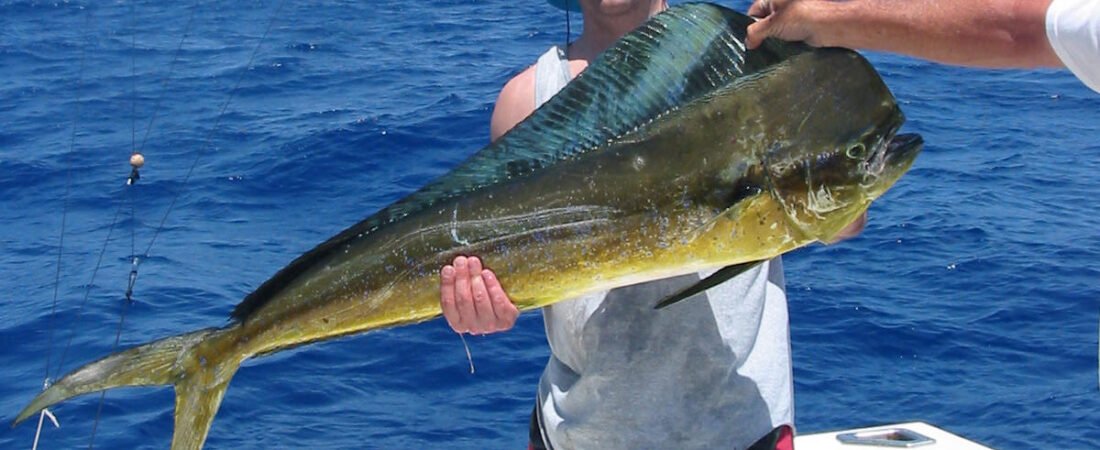
Quick answer: Yes and no. Atlantic and Pacific mahi mahi are the exact same species, Coryphaena hippurus, with identical biology and appearance. But genome-wide genetic studies have found they form distinct, separately breeding populations tied to their ocean basin, which is why fisheries agencies manage and report on “Atlantic mahi mahi” and “Pacific mahimahi” as separate stocks even though no visual or anatomical difference exists between them.
It’s a fair question, since fisheries agencies clearly treat Atlantic and Pacific mahi mahi as separate things. NOAA maintains entirely separate pages, separate stock assessments, and separate management rules for each. Here’s what’s actually different, and what isn’t.
Same Species, Confirmed by Genetics
There’s no ambiguity on this point: every mahi mahi in every ocean is Coryphaena hippurus, the species Linnaeus described in 1758. A large-scale genome-wide study using roughly 8.7 million genetic markers plus full mitochondrial genome data confirmed there’s no separate species or subspecies involved anywhere in the world. Physically, an Atlantic-caught fish and a Pacific-caught fish are indistinguishable.
But Genetically Distinct Populations
What that same genetic research also revealed is more interesting: mahi mahi form four separate, genetically distinguishable population groups, corresponding almost exactly to the major ocean basins, the Atlantic, the Pacific, the Indian Ocean, and the Mediterranean Sea. These populations don’t interbreed in any meaningful way, likely because there simply isn’t enough natural movement of fish between ocean basins to mix their gene pools, despite mahi mahi being capable of migrating thousands of miles within a single basin.
Why That Difference Matters for Management
Because Atlantic and Pacific mahi mahi function as separate breeding populations, fisheries regulators manage them independently rather than as one global pool. In the United States, roughly a third of commercial mahi mahi harvest comes from the Atlantic, Gulf of Mexico, and Caribbean combined, while the majority comes from the Pacific, primarily around Hawaii. Within the Atlantic alone, U.S. regulators further divide the population into four separate stocks and stock complexes: South Atlantic, St. Croix, St. Thomas/St. John, and the Puerto Rico Dolphinfish Complex.
| Atlantic Mahi Mahi | Pacific Mahi Mahi | |
|---|---|---|
| Species | Coryphaena hippurus | Coryphaena hippurus (same species) |
| Genetic population | Distinct Atlantic stock | Distinct Pacific stock |
| Main U.S. source | Gulf, Caribbean, South Atlantic | Primarily Hawaii |
| Share of U.S. harvest | ~1/3 | ~2/3 |
Regional Studies Are Refining This Further
Even within the Pacific, research has found finer-grained genetic structure than a single uniform population. A regional study in the tropical Eastern Pacific identified distinct genetic groups of mahi mahi within that one stretch of ocean alone, prompting discussion among fisheries scientists about whether management approaches need to get more localized than the current basin-wide model. The overall picture is a species that’s biologically uniform but structured into real, separately evolving populations at a scale finer than most people would assume for a fish that migrates thousands of miles in its own lifetime.
Same fish, same biology, same name on every menu worldwide, but genetically, mahi mahi are organized into distinct regional populations that don’t mix much across ocean basins, which is exactly why management stays separate even though the species doesn’t.
Are Atlantic and Pacific mahi mahi different species?
No. Both are Coryphaena hippurus, the same species, confirmed by genome-wide genetic analysis with no taxonomic split.
Why does NOAA manage them separately then?
Because genetic studies show Atlantic and Pacific mahi mahi form distinct, largely non-interbreeding populations, so regulators track and manage each ocean basin’s stock independently.
Do Atlantic and Pacific mahi mahi look different?
No. There’s no visual or anatomical difference between them. The distinction is entirely genetic and only detectable through DNA analysis.
Explore the rest of the Mahi Mahi series
Biology & Identification
- Mahi Mahi: Full Species Overview
- Why Male Mahi Mahi Have That Distinctive Flat Forehead
- Bull vs Cow Mahi Mahi: How to Tell the Male and Female Apart
- Why Mahi Mahi Changes Colour: The Blue, Gold, and Green Explained
- Why Is Mahi Mahi Called Dolphinfish? The Name Confusion Explained
- Other Names for Mahi Mahi: Dorado, Dolphinfish, and Why It Has So Many
- Mahi Mahi Scientific Name: Coryphaena Hippurus and Its Taxonomy Explained
- What Kind of Fish Is Mahi Mahi? Classification, Family, and Biology
- Mahi Mahi Facts: 10 Things Most People Do Not Know
Habitat & Behavior
- Mahi Mahi Spawning and Reproduction: How They Breed and How Fast They Grow
- How Long Do Mahi Mahi Live? Lifespan, Growth Rate, and Maturity
- What Eats Mahi Mahi? Natural Predators in the Ocean
- How Fast Can Mahi Mahi Swim? Speed, Agility, and Why They Are Hard to Land
- What Do Mahi Mahi Eat? Diet, Prey, and Feeding Habits in the Wild
- Mahi Mahi Migration: How They Follow Warm Currents Around the World
- Mahi Mahi Habitat: Why They Hang Around Sargassum and Floating Debris
- Where Do Mahi Mahi Live? Ocean, Depth, and Temperature Preferences
- Baby Mahi Mahi: Should You Release Juvenile Mahi and How to Identify Them
Size & Records
- How Big Do Mahi Mahi Get? Size, Weight, and World Record
- Mahi Mahi World Record: Biggest Ever Caught and Where
Food & Health
- Fresh vs Frozen Mahi Mahi: Does It Make a Difference?
- Wild-Caught vs Farmed Mahi Mahi: What Is the Difference?
- Is Mahi Mahi a Sustainable Seafood Choice?
- Fish Similar to Mahi Mahi: What to Buy When It Is Not Available
- Mahi Mahi vs Tuna, Salmon, and Grouper: How Does It Compare?
- Can Dogs Eat Mahi Mahi? What Is Safe and What to Watch Out For
- Is Mahi Mahi Safe to Eat During Pregnancy? Mercury and Safety Explained
- Mahi Mahi Mercury Levels: Is It Safe and How Often Can You Eat It?
- Is Mahi Mahi Good to Eat? What Makes It One of the Most Popular Fish
- Mahi Mahi Nutrition Facts: Protein, Omega-3, Calories, and Vitamins
- Is Mahi Mahi a White Fish? Flesh Colour, Texture, and How It Compares
- What Does Mahi Mahi Taste Like? Flavour, Texture, and Is It Fishy?
- Mahi Mahi Population: Are Numbers Healthy and Is Overfishing a Risk?
- Mahi Mahi and Bycatch: What Gets Caught Alongside It and Why It Matters
Fishing
- Mahi Fishing Tips: Rigs, Trolling Speeds, and What Actually Works
- How to Catch Mahi Mahi: Techniques, Tackle, and Where to Find Them
- Mahi Mahi Fishing: Everything You Need to Know to Find and Catch Them
- Mahi Mahi Fishing in Florida: Season, Hotspots, and How to Catch Them
- Where to Catch Mahi Mahi: Best Locations Around the World
- Mahi Mahi Fishing Charters: What to Expect and How to Choose One
- Mahi Mahi Season: When and Where to Fish for Peak Action
- Best Lures for Mahi Mahi: What They Strike and Why
- Trolling for Mahi Mahi: Speed, Spread, and Setup Explained
- Finding Mahi Mahi on Sargassum Lines: Why Weed Lines Are the Key
- Mahi Mahi Fishing in Hawaii: When to Go and What to Expect