
A mahi mahi caught on a typical charter trip and a mahi mahi in the record books can be almost different animals in size, separated by growth math that outpaces nearly every other fish in the ocean. Understanding how big mahi mahi actually get means separating three different numbers that often get blurred together: what’s typical, what’s exceptional, and what’s the outright record.
Here’s the full breakdown of mahi mahi size and weight, and how growth rate explains why the range is so wide.
Size At A Glance
What a Typical Mahi Mahi Weighs
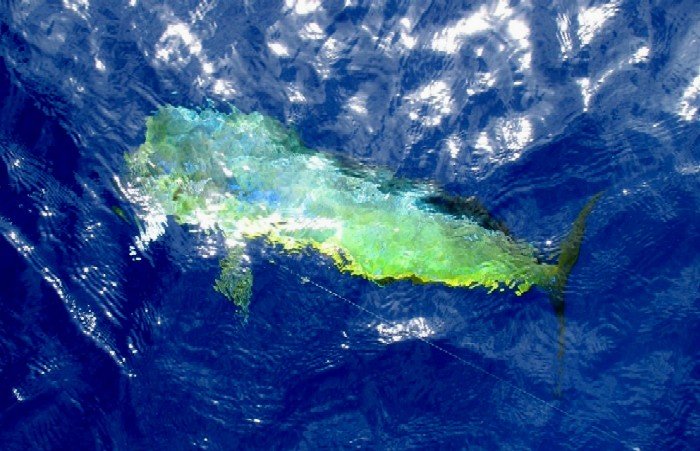
Most mahi mahi brought to the dock fall between 15 and 30 pounds, with an overall length somewhere between 33 and 55 inches. Fish over 40 pounds are uncommon enough that most captains remember them individually, and anything approaching 50 pounds or more counts as a genuinely exceptional catch on any trip. The vast majority of fish caught, even by experienced offshore anglers, never get close to the fish that make the record books.
Why the Growth Rate Explains the Range
The size spread makes more sense once the growth curve is factored in. Mahi mahi can gain up to roughly 6 inches of length in a single month during their first year of life, among the fastest growth rates of any wild fish. A fish reaches roughly a meter, about 3.3 feet, within its first year alone, and full adult size within about 12 months of hatching. Because mahi mahi only live 4 to 5 years total, nearly every fish caught is young relative to its lifespan, and a fish’s final size depends heavily on exactly how much of that short life it survived before being caught.
| Growth Stage | Approximate Age | Approximate Size |
|---|---|---|
| Market size | ~2 years | 10-12 in |
| Typical adult catch | 1-2 years | 33-55 in, 15-30 lb |
| Exceptional fish | 2-4 years | 40+ lb |
| Record-class fish | Near max lifespan | 80+ lb |
How Big the Record Books Go
The all-tackle world record stands at 87 pounds, caught off Costa Rica in 1976, a fish nearly three times the weight of an average catch. Records tracked by line class, tippet class, and age group tell a similar story: even the lighter-tackle records regularly top 50 to 75 pounds, weights that would be considered remarkable on any given trip. The full story behind the record, including a 102-pound fish that nearly broke it in 2015, is covered in detail in a dedicated article rather than repeated here.
A Note on the Family’s Other Species
For comparison, mahi mahi’s only relative, the pompano dolphinfish (Coryphaena equiselis), rarely exceeds 75 to 95 cm in length, less than half the maximum size mahi mahi can reach. The size gap is actually one of the more reliable ways to tell the two species apart in the water, alongside body depth and tooth patch shape.
Most mahi mahi never come close to their theoretical maximum size, simply because they don’t live long enough. The fish that do reach 60, 70, or 80-plus pounds are the rare survivors of a species built to grow fast and live short.
Explore the rest of the Mahi Mahi series
Biology & Identification
- Mahi Mahi: Full Species Overview
- Why Male Mahi Mahi Have That Distinctive Flat Forehead
- Bull vs Cow Mahi Mahi: How to Tell the Male and Female Apart
- Why Mahi Mahi Changes Colour: The Blue, Gold, and Green Explained
- Why Is Mahi Mahi Called Dolphinfish? The Name Confusion Explained
- Other Names for Mahi Mahi: Dorado, Dolphinfish, and Why It Has So Many
- Mahi Mahi Scientific Name: Coryphaena Hippurus and Its Taxonomy Explained
- What Kind of Fish Is Mahi Mahi? Classification, Family, and Biology
- Mahi Mahi Facts: 10 Things Most People Do Not Know
Habitat & Behavior
- Mahi Mahi Spawning and Reproduction: How They Breed and How Fast They Grow
- How Long Do Mahi Mahi Live? Lifespan, Growth Rate, and Maturity
- What Eats Mahi Mahi? Natural Predators in the Ocean
- How Fast Can Mahi Mahi Swim? Speed, Agility, and Why They Are Hard to Land
- What Do Mahi Mahi Eat? Diet, Prey, and Feeding Habits in the Wild
- Mahi Mahi in the Atlantic vs Pacific: Are They the Same Fish?
- Mahi Mahi Migration: How They Follow Warm Currents Around the World
- Mahi Mahi Habitat: Why They Hang Around Sargassum and Floating Debris
- Where Do Mahi Mahi Live? Ocean, Depth, and Temperature Preferences
- Baby Mahi Mahi: Should You Release Juvenile Mahi and How to Identify Them
Size & Records
Food & Health
- Fresh vs Frozen Mahi Mahi: Does It Make a Difference?
- Wild-Caught vs Farmed Mahi Mahi: What Is the Difference?
- Is Mahi Mahi a Sustainable Seafood Choice?
- Fish Similar to Mahi Mahi: What to Buy When It Is Not Available
- Mahi Mahi vs Tuna, Salmon, and Grouper: How Does It Compare?
- Can Dogs Eat Mahi Mahi? What Is Safe and What to Watch Out For
- Is Mahi Mahi Safe to Eat During Pregnancy? Mercury and Safety Explained
- Mahi Mahi Mercury Levels: Is It Safe and How Often Can You Eat It?
- Is Mahi Mahi Good to Eat? What Makes It One of the Most Popular Fish
- Mahi Mahi Nutrition Facts: Protein, Omega-3, Calories, and Vitamins
- Is Mahi Mahi a White Fish? Flesh Colour, Texture, and How It Compares
- What Does Mahi Mahi Taste Like? Flavour, Texture, and Is It Fishy?
- Mahi Mahi Population: Are Numbers Healthy and Is Overfishing a Risk?
- Mahi Mahi and Bycatch: What Gets Caught Alongside It and Why It Matters
Fishing
- Mahi Fishing Tips: Rigs, Trolling Speeds, and What Actually Works
- How to Catch Mahi Mahi: Techniques, Tackle, and Where to Find Them
- Mahi Mahi Fishing: Everything You Need to Know to Find and Catch Them
- Mahi Mahi Fishing in Florida: Season, Hotspots, and How to Catch Them
- Where to Catch Mahi Mahi: Best Locations Around the World
- Mahi Mahi Fishing Charters: What to Expect and How to Choose One
- Mahi Mahi Season: When and Where to Fish for Peak Action
- Best Lures for Mahi Mahi: What They Strike and Why
- Trolling for Mahi Mahi: Speed, Spread, and Setup Explained
- Finding Mahi Mahi on Sargassum Lines: Why Weed Lines Are the Key
- Mahi Mahi Fishing in Hawaii: When to Go and What to Expect