
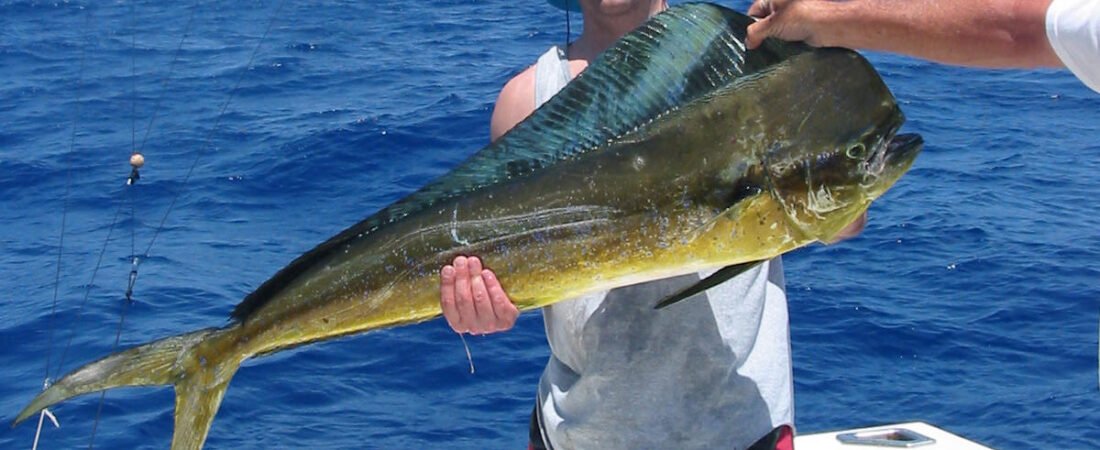
Every mahi mahi swimming in the ocean today carries a name assigned in 1758. Coryphaena hippurus is one of the older scientific names still in active use for a major sport fish, and unlike a lot of Latin binomials, both halves of it actually describe something real about the animal once you translate them.
Here’s the full breakdown: what the name means, who assigned it, and where mahi mahi sits on the broader tree of life.
What Coryphaena Hippurus Actually Means
The genus name Coryphaena comes from Ancient Greek, combining korys, meaning “helmet,” with phainein, “to show” or “make manifest.” Together, it roughly translates to “the one that shows a helmet,” a reference to the bony, crested shape of the adult male’s head. The species name hippurus comes from hippos (“horse”) and oura (“tail”), describing how the long dorsal fin tapers back toward the tail the way a horse’s mane runs down its neck. Put together, the scientific name is a physical description hiding in plain sight: helmet-headed, horse-tailed.
Who Named It, and When
The name was assigned by Carl Linnaeus, the Swedish botanist and zoologist who created the modern system of binomial nomenclature still used across biology today. Mahi mahi appears in the 10th edition of his landmark work Systema Naturae, published in 1758, the same edition widely treated as the formal starting point for modern zoological naming. Few sport fish caught today still carry a name from that original 1758 edition without having been reclassified into a different genus since.
That stability is unusual. Linnaeus described thousands of species in his lifetime working from limited specimens and no genetic tools, and a huge share of his original names have since been split, merged, or moved into entirely different genera as later scientists found the classifications didn’t hold up. Coryphaena hippurus is one of the exceptions: the genus and species name he assigned in 1758 remain the accepted name today, even though the order it sits within has changed.
Where It Sits on the Tree of Life
Full Classification
That order, Carangiformes, is a relatively recent addition to the classification. Mahi mahi was traditionally filed under the much broader order Perciformes, a grouping that held a huge share of the world’s ray-finned fish based mostly on physical resemblance. Genetic sequencing over the past decade rewrote large parts of that structure, and mahi mahi was moved into Carangiformes alongside jacks and trevallies, fish it shares real evolutionary history with rather than just superficial similarity.
Its Only Relative
The genus Coryphaena contains exactly one other species: Coryphaena equiselis, the pompano dolphinfish. The two are similar enough to confuse in the water, especially as juveniles, but a few measurable differences separate them. C. hippurus grows much larger, up to roughly 200 cm, while C. equiselis tops out closer to 75 to 95 cm. The pompano dolphinfish also has a noticeably deeper body relative to its length, and its tooth patch on the tongue is broad and square rather than small and oval.
| Trait | C. hippurus (Mahi Mahi) | C. equiselis (Pompano Dolphinfish) |
|---|---|---|
| Max length | ~200 cm | ~75-95 cm |
| Body depth | Less than 25% of length | More than 25% of length |
| Tongue tooth patch | Small, oval | Broad, square |
Nearly 270 years after Linnaeus wrote it down, Coryphaena hippurus is still the accepted name for mahi mahi worldwide, and it’s one of the rare cases where a Latin binomial actually tells you something true just by translating it.
Explore the rest of the Mahi Mahi series
Biology & Identification
- Mahi Mahi: Full Species Overview
- Why Male Mahi Mahi Have That Distinctive Flat Forehead
- Bull vs Cow Mahi Mahi: How to Tell the Male and Female Apart
- Why Mahi Mahi Changes Colour: The Blue, Gold, and Green Explained
- Why Is Mahi Mahi Called Dolphinfish? The Name Confusion Explained
- Other Names for Mahi Mahi: Dorado, Dolphinfish, and Why It Has So Many
- What Kind of Fish Is Mahi Mahi? Classification, Family, and Biology
- Mahi Mahi Facts: 10 Things Most People Do Not Know
Habitat & Behavior
- Mahi Mahi Spawning and Reproduction: How They Breed and How Fast They Grow
- How Long Do Mahi Mahi Live? Lifespan, Growth Rate, and Maturity
- What Eats Mahi Mahi? Natural Predators in the Ocean
- How Fast Can Mahi Mahi Swim? Speed, Agility, and Why They Are Hard to Land
- What Do Mahi Mahi Eat? Diet, Prey, and Feeding Habits in the Wild
- Mahi Mahi in the Atlantic vs Pacific: Are They the Same Fish?
- Mahi Mahi Migration: How They Follow Warm Currents Around the World
- Mahi Mahi Habitat: Why They Hang Around Sargassum and Floating Debris
- Where Do Mahi Mahi Live? Ocean, Depth, and Temperature Preferences
- Baby Mahi Mahi: Should You Release Juvenile Mahi and How to Identify Them
Size & Records
- How Big Do Mahi Mahi Get? Size, Weight, and World Record
- Mahi Mahi World Record: Biggest Ever Caught and Where
Food & Health
- Fresh vs Frozen Mahi Mahi: Does It Make a Difference?
- Wild-Caught vs Farmed Mahi Mahi: What Is the Difference?
- Is Mahi Mahi a Sustainable Seafood Choice?
- Fish Similar to Mahi Mahi: What to Buy When It Is Not Available
- Mahi Mahi vs Tuna, Salmon, and Grouper: How Does It Compare?
- Can Dogs Eat Mahi Mahi? What Is Safe and What to Watch Out For
- Is Mahi Mahi Safe to Eat During Pregnancy? Mercury and Safety Explained
- Mahi Mahi Mercury Levels: Is It Safe and How Often Can You Eat It?
- Is Mahi Mahi Good to Eat? What Makes It One of the Most Popular Fish
- Mahi Mahi Nutrition Facts: Protein, Omega-3, Calories, and Vitamins
- Is Mahi Mahi a White Fish? Flesh Colour, Texture, and How It Compares
- What Does Mahi Mahi Taste Like? Flavour, Texture, and Is It Fishy?
- Mahi Mahi Population: Are Numbers Healthy and Is Overfishing a Risk?
- Mahi Mahi and Bycatch: What Gets Caught Alongside It and Why It Matters
Fishing
- Mahi Fishing Tips: Rigs, Trolling Speeds, and What Actually Works
- How to Catch Mahi Mahi: Techniques, Tackle, and Where to Find Them
- Mahi Mahi Fishing: Everything You Need to Know to Find and Catch Them
- Mahi Mahi Fishing in Florida: Season, Hotspots, and How to Catch Them
- Where to Catch Mahi Mahi: Best Locations Around the World
- Mahi Mahi Fishing Charters: What to Expect and How to Choose One
- Mahi Mahi Season: When and Where to Fish for Peak Action
- Best Lures for Mahi Mahi: What They Strike and Why
- Trolling for Mahi Mahi: Speed, Spread, and Setup Explained
- Finding Mahi Mahi on Sargassum Lines: Why Weed Lines Are the Key
- Mahi Mahi Fishing in Hawaii: When to Go and What to Expect